
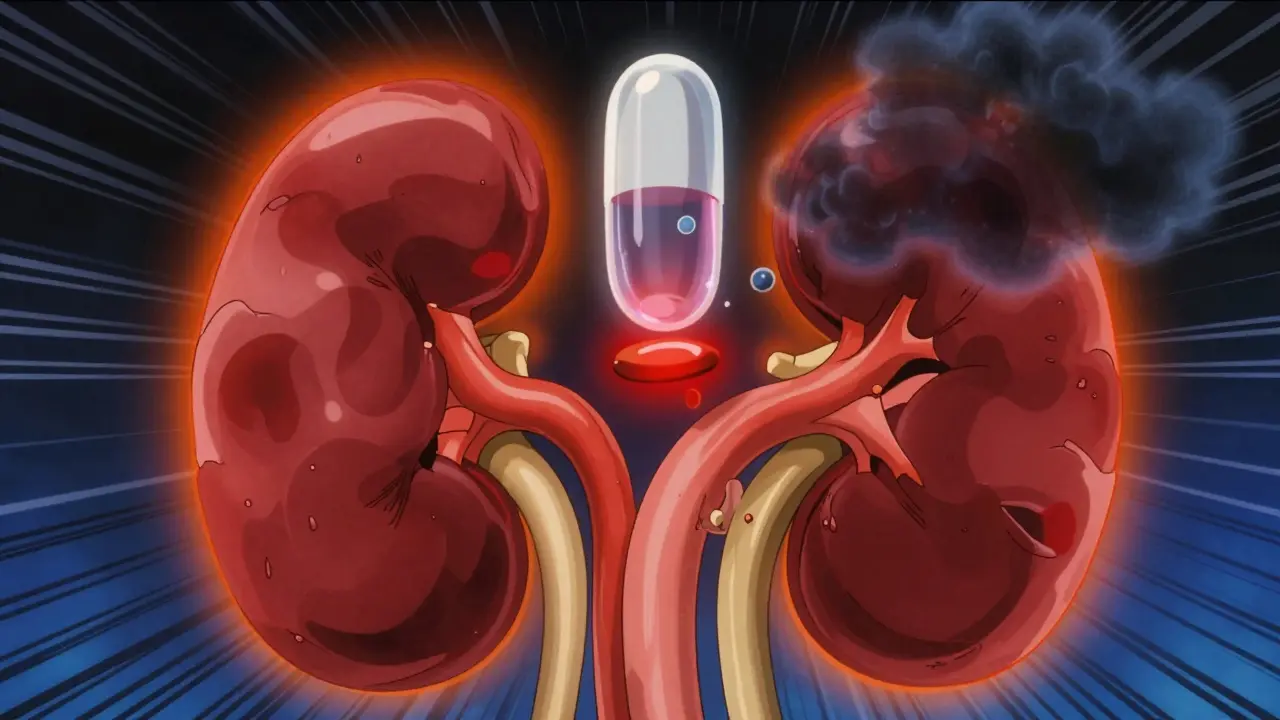
When your kidneys don’t get enough blood, your body tries to compensate. It releases renin, which triggers a chain reaction leading to angiotensin II - a powerful chemical that squeezes blood vessels to raise pressure. That’s fine if you’re healthy. But if you have renal artery stenosis, this system becomes a lifeline. And that’s exactly why taking ACE inhibitors can be risky.
ACE inhibitors are common blood pressure drugs. They work by blocking the enzyme that makes angiotensin II. That’s why they help lower pressure, protect the heart, and slow kidney damage in people with diabetes. But in patients with narrowed renal arteries, that same mechanism can cause sudden, serious kidney failure.
How Renal Artery Stenosis Works
Renal artery stenosis means one or both arteries leading to your kidneys are narrowed - often by plaque buildup (atherosclerosis) or fibromuscular dysplasia. When blood flow drops, the kidney thinks it’s in danger. So it screams for help by releasing renin. That sets off the renin-angiotensin-aldosterone system (RAAS). The result? Angiotensin II tightens the efferent arteriole - the tiny outflow tube in the kidney’s filtering unit.
This isn’t just about high blood pressure. It’s about survival. That constriction keeps pressure high inside the glomerulus, the part of the kidney that filters waste. Without it, filtration crashes. In a healthy kidney, this mechanism barely kicks in. But in a stenotic kidney, angiotensin II is doing 90% of the work just to keep things running.
What Happens When You Take an ACE Inhibitor
Now imagine you start taking lisinopril or enalapril. The drug shuts down angiotensin II production. Suddenly, that critical efferent arteriole relaxes. Pressure inside the glomerulus drops by 25-30%. Filtration slows. Creatinine rises. Within days, your kidneys start to shut down.
This isn’t theoretical. A landmark 1984 study in the New England Journal of Medicine showed 12 out of 15 patients with bilateral renal artery stenosis developed acute kidney failure after taking captopril. That pattern has been confirmed again and again.
A 2001 study using micropuncture techniques found angiotensin II increases efferent resistance by nearly 38% in stenotic kidneys - compared to just 8% in normal ones. When ACE inhibitors block that, the drop in filtration pressure is sharp and fast. The result? A spike in serum creatinine of more than 30% within 7 to 10 days. That’s the red flag doctors look for.
Bilateral vs. Unilateral: The Critical Difference
Not all renal artery stenosis is the same. If only one kidney is affected and the other works fine, ACE inhibitors are often safe. The healthy kidney picks up the slack. But if both kidneys are narrowed - or if you have only one functioning kidney - you’re in danger.
That’s why guidelines are clear: ACE inhibitors are contraindicated in bilateral renal artery stenosis or stenosis in a solitary kidney. This isn’t a gray area. It’s a hard stop.
A 2017 follow-up to the ASTRAL trial showed patients with bilateral stenosis who took ACE inhibitors lost an average of 18.7 mL/min/1.73m² in eGFR over time. Those without stenosis? Just a 3.2 decline. The difference was dramatic. And irreversible in some cases.
What About ARBs? Are They Safer?
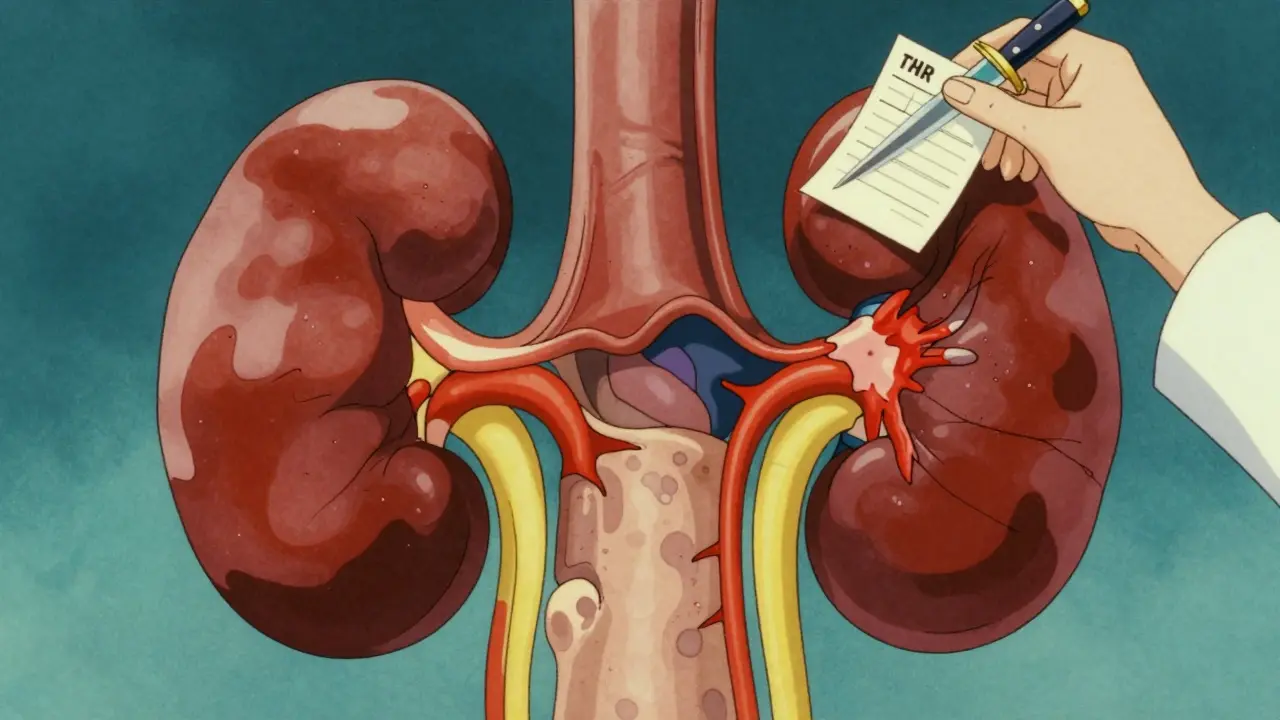
No. Angiotensin receptor blockers (ARBs) like losartan or valsartan work differently - they block the receptor instead of making angiotensin II. But they don’t fix the problem. They still remove the vasoconstrictive effect on the efferent arteriole. That means the same drop in glomerular pressure. Same risk of kidney failure.
The 2019 KDIGO guidelines explicitly list ARBs as contraindicated for the same conditions as ACE inhibitors. There’s no safe substitute here. Switching from an ACE inhibitor to an ARB won’t help if renal artery stenosis is the root issue.
Who’s at Risk?
You don’t need a diagnosis to be at risk. Certain people are more likely to have undiagnosed renal artery stenosis:
- People over 60 with new-onset high blood pressure
- Those with sudden kidney function decline after starting blood pressure meds
- Patients with abdominal bruits (a whooshing sound heard with a stethoscope)
- Anyone with accelerated hypertension or unexplained kidney damage
Studies show about 6.8% of hypertensive patients with kidney impairment have significant stenosis. That’s not rare. And it’s often missed.
How Doctors Screen for It
Before starting an ACE inhibitor, especially in high-risk patients, guidelines recommend checking renal function and potassium levels. That’s step one.
Step two? Repeat the blood test 7 to 10 days after starting the drug. A rise in creatinine over 30% is a warning sign. It doesn’t mean you have stenosis - but it means you need further testing.
The go-to test? Renal artery duplex ultrasound. It’s non-invasive, widely available, and detects significant narrowing with 86% sensitivity and 92% specificity. If the ultrasound is positive, a CT angiogram or MR angiogram may follow.
The National Institute for Health and Care Excellence (NICE) says if creatinine is above 150 micromol/L, ACE inhibitors should only be started under specialist supervision. Many primary care providers still miss this.
The Real-World Problem
Despite decades of clear evidence, a 2020 study found that 22.4% of patients with known bilateral renal artery stenosis were still being prescribed ACE inhibitors in primary care. Why? Because it’s easy to overlook. The patient has high blood pressure. The doctor sees diabetes. The kidney function looks okay - until it isn’t.
That’s dangerous. In one retrospective study of 1,247 patients, 18.7% of those with undiagnosed bilateral stenosis developed acute kidney injury after starting an ACE inhibitor. That’s nearly 1 in 5. The control group? Just 2.3%.
And while the kidney damage is often reversible if caught early, if hypoperfusion lasts more than 72 hours, permanent injury can occur. Some patients end up on dialysis.
What Should You Do?
If you’re prescribed an ACE inhibitor and have risk factors - especially if you’re over 60, have unexplained kidney changes, or have a history of vascular disease - ask your doctor:
- Have I been screened for renal artery stenosis?
- What’s my creatinine level before and after starting this drug?
- Am I at risk for bilateral stenosis?
Don’t assume your kidney function is fine just because you feel okay. The damage happens silently. Creatinine is the clue.
If you’re already on an ACE inhibitor and your creatinine jumps more than 30% in 10 days, contact your provider immediately. Stop the drug. Get tested. The sooner you act, the better your chances of full recovery.
There’s no shame in having renal artery stenosis. But there’s real risk in ignoring it. ACE inhibitors save lives - but they can also take them if used without understanding the underlying condition.



This is wild I had no idea ACE inhibitors could cause kidney failure like that
My grandma was on lisinopril for years and her kidneys just kinda crashed one day
Doctors never mentioned this risk at all
I really appreciate how clearly this breaks down the physiology. Most people think of ACE inhibitors as just another blood pressure pill, but this shows how deeply they interact with kidney autoregulation. The efferent arteriole constriction is such a clever evolutionary adaptation - until it isn't. It's terrifying how a drug meant to protect can become a silent killer in the right context.
The clinical evidence is unequivocal. The 1984 NEJM study remains a cornerstone of nephrology education. The 30% creatinine rise threshold is not arbitrary - it reflects a physiologically significant drop in glomerular filtration pressure. Any clinician who ignores this is practicing malpractice by omission.
This is why Western medicine is so dangerously simplistic
You treat symptoms without understanding systems
Renal artery stenosis is not a disease - it is a warning sign of systemic vascular decay
And yet we throw pills at it like it's a broken faucet
I bet Big Pharma knows about this and hides it
ACE inhibitors are billion-dollar drugs
Imagine if everyone knew the risk - sales would crater overnight
And don't get me started on how the FDA approves these without mandatory renal screening
They're all in on the game 😈
You people are too soft. This isn't rocket science. If your kidney is already failing, don't give it a drug that cuts off its last lifeline. That's not medicine - that's negligence. And if your doctor prescribes this without checking for stenosis first, you should sue them into oblivion. No mercy.
So basically if you're old and on blood pressure meds, just don't take ACE inhibitors at all? That's it? No testing? No warning labels? I'm out. I'm switching to whatever's cheaper and less likely to kill me.
The KDIGO guidelines are clear, and yet primary care physicians continue to violate them with alarming frequency. This is not a failure of knowledge - it is a failure of diligence. The 22.4% rate of inappropriate prescribing in primary care is not an accident. It is systemic negligence cloaked in convenience.
You know what's funny? In Australia we don't even use ACE inhibitors as first-line anymore. We start with calcium channel blockers or thiazides. Why? Because we've seen what happens when you give these drugs to people with silent stenosis. It's not a controversy - it's a cautionary tale. The US is still stuck in the 90s.
I just got my creatinine checked and it jumped 35% after starting lisinopril 😱
My doctor said 'it's fine, it's normal' but now I'm scared
Should I stop it? I don't want to get dialysis
This is why America's healthcare system is a joke. You're supposed to be safe, but you're just a number in a spreadsheet. No one checks. No one cares. My uncle died because his doctor didn't think to test for stenosis. He was 68. Had diabetes. Took his pills. And then - poof. Gone.
I'm so glad someone finally put this out there. So many people don't realize how delicate kidney function is. It's not just about numbers - it's about survival. I work in a clinic and I've seen patients turn from fine to dialysis-dependent in under two weeks. It's heartbreaking. Always check creatinine before and after. Always.
ARBs? Same mechanism. Same outcome. Stop pretending there's a loophole. If you have stenosis, you're not getting ACE or ARB. Period. This isn't a choice - it's a law of physiology.
The efferent arteriole is the last line of defense. Block angiotensin II? You're removing the pressure gradient that keeps glomerular filtration alive. That's not a side effect - it's the intended pharmacological action. The kidney fails because the drug does its job too well.
This is a textbook example of how pharmacological intervention must be context-sensitive. The same drug that preserves renal function in diabetic nephropathy can obliterate it in renal artery stenosis. Medicine is not one-size-fits-all. We must move beyond algorithmic prescribing and embrace clinical judgment.