
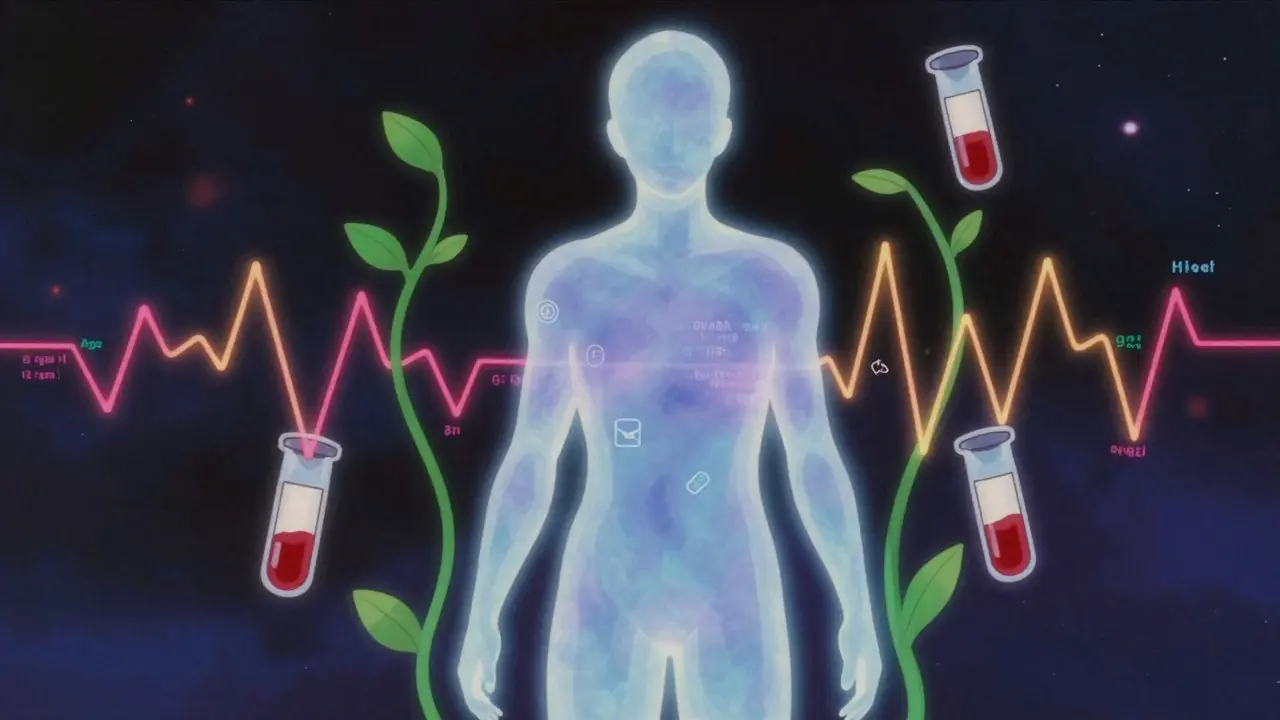
When two drugs are supposed to do the same thing, how do you know they really do? For generic drugs or biosimilars, regulators don’t just rely on lab tests or marketing claims. They need hard data showing that the body handles them the same way. That’s where population pharmacokinetics comes in - a powerful, data-driven method used to prove drug equivalence without needing dozens of healthy volunteers to give blood every 30 minutes.
Traditional bioequivalence studies used to be the gold standard. You’d recruit 24 to 48 healthy adults, give them one drug, then wait a few weeks and give them the other. You’d take blood samples every 15 to 30 minutes for 24 to 48 hours. You’d measure how much drug got into the bloodstream, how fast it peaked, and how long it stayed. Then you’d compare the average numbers. If the ratio of the two drugs’ exposure (AUC) and peak concentration (Cmax) fell between 80% and 125%, you called them equivalent.
But that approach has big holes. What if the drug is meant for elderly patients with kidney problems? Or kids? Or people on five other medications? You can’t ethically or practically run those intensive studies on every subgroup. That’s where population pharmacokinetics - or PopPK - changes the game.
What Is Population Pharmacokinetics?
PopPK isn’t about one person’s perfect data. It’s about taking messy, real-world data from many people - patients in hospitals, people in clinical trials, even those getting routine blood tests - and using math to find patterns. Instead of needing 10 blood draws per person, PopPK works with just 2 or 3 samples per patient, collected at random times. It doesn’t require a controlled lab setting. It thrives in chaos.
The core idea is simple: everyone’s body handles drugs differently. Weight, age, liver function, genetics, other meds - all these things change how a drug moves through the body. PopPK models these differences using nonlinear mixed-effects modeling. Think of it like a statistical detective: it looks at the data from hundreds of people, figures out what’s normal variation, and then isolates what’s caused by specific factors - like whether someone weighs 50 kg or 100 kg, or if their kidneys are working at 30% capacity.
This method was first developed in the late 1970s by Dr. Lewis Sheiner and colleagues. Back then, it was theoretical. Now, it’s standard. The FDA published formal guidance in February 2022, saying PopPK data can replace some postmarketing studies. That’s huge. It means companies can save millions in clinical trial costs and get life-saving drugs to patients faster - if the data holds up.
How PopPK Proves Equivalence
Let’s say you’re making a generic version of a drug used to treat seizures. The brand-name version has a narrow therapeutic window - too little and the patient seizes; too much and they get dizzy or fall into a coma. You need to prove your version delivers the same exposure across all patients, not just on average.
With traditional bioequivalence, you might test 30 healthy adults. But what if 15% of actual patients have moderate kidney disease? You wouldn’t know if your generic is safe for them. PopPK lets you include those patients from day one. You collect sparse samples from 50 patients - some with normal kidneys, some with reduced function, some on diuretics, some elderly. You feed that data into a PopPK model.
The model tells you: “Patients with creatinine clearance under 40 mL/min have 35% higher drug exposure.” Then it compares your generic to the brand in that subgroup. If the difference in exposure stays within 20% - and you can show that 95% of patients in both groups fall within safe, effective levels - you’ve proven equivalence in a real-world population, not just a lab group.
This isn’t just theory. Merck used PopPK to show equivalence for a heart drug across patients with varying liver function. Pfizer did the same for a cancer drug in pediatric patients. Both avoided separate pediatric trials, which are expensive and ethically tricky. The FDA accepted their submissions without demanding additional studies.
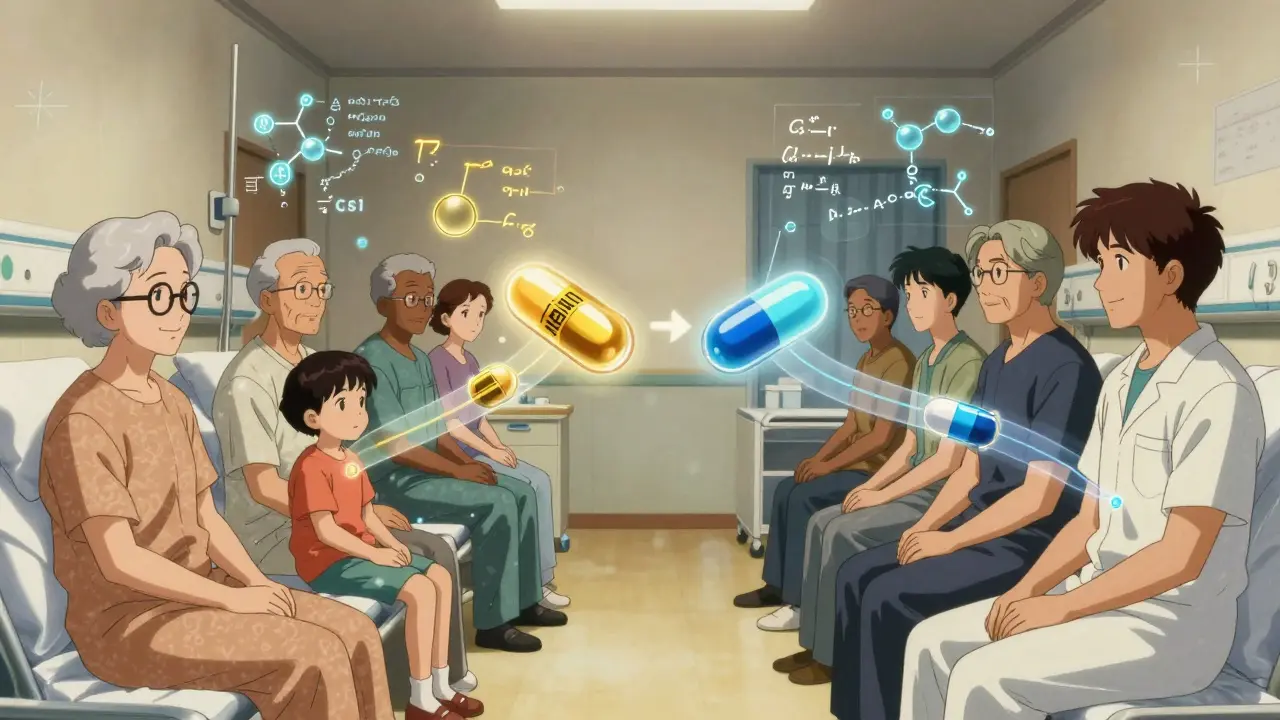
PopPK vs. Traditional Bioequivalence: The Trade-Offs
PopPK isn’t better in every way. It’s just better for specific situations.
Traditional studies give you very precise numbers. They control every variable. You know exactly how much drug each person got, when they got it, and how their body responded. That precision makes them ideal for drugs with highly variable metabolism - like warfarin or phenytoin - where small differences matter a lot.
PopPK, on the other hand, gives you depth, not just precision. It tells you not just if two drugs are equivalent on average, but for whom they’re equivalent. It shows you the full spread of exposure across a diverse group. That’s why regulators now prefer it for drugs used in elderly, pediatric, or chronically ill populations.
But here’s the catch: PopPK needs good data. If the clinical trial only sampled patients once, at random times, with no info on weight or lab values, the model can’t do its job. You need covariates - patient characteristics - built into the data from the start. Many companies learn this the hard way. A 2021 analysis of FDA rejection letters found that 30% of PopPK submissions were sent back because the data was too sparse or poorly documented.
Also, PopPK requires expertise. You need pharmacometricians who know how to build, validate, and interpret nonlinear mixed-effects models. Tools like NONMEM, Monolix, and Phoenix NLME are industry standards, but they’re not user-friendly. It takes 18 to 24 months of training to become proficient. And even then, validation is tricky. There’s no single agreed-upon method to prove a model is “right.” That’s why some regulatory reviewers still hesitate, especially outside the U.S.
Real-World Use Cases and Industry Trends
PopPK isn’t just for generics. It’s critical for biosimilars - copies of complex biologic drugs like Humira or Enbrel. These aren’t small molecules you can chemically replicate. They’re proteins made in living cells. Their structure is too complex for traditional bioequivalence tests. PopPK is one of the few tools that can show the body processes the biosimilar the same way as the original.
According to a 2023 report by Grand View Research, the global pharmacometrics market - fueled mostly by PopPK - is growing at 14.3% per year. It’s expected to hit $1.27 billion by 2029. Why? Because 92% of the top 25 pharmaceutical companies now have dedicated pharmacometrics teams, up from 65% in 2015. These teams don’t just run models. They’re involved from Phase 1, helping design trials so they collect the right data from the start.
One company in Manchester told me (in confidence) that they cut their development timeline by 11 months on a new epilepsy drug by using PopPK instead of running a separate study in patients with renal impairment. That’s not just cost savings. That’s faster access to treatment for people who need it.
Machine learning is now being layered on top of PopPK. A January 2025 study in Nature showed that adding neural networks helped detect hidden interactions - like how a specific gene variant combined with a common antibiotic could spike drug levels in 8% of patients. That’s something traditional models might miss. This isn’t sci-fi. It’s happening now.

Challenges and Where the Field Is Headed
PopPK has hurdles. The biggest? Validation. There’s no universal checklist. One regulator might accept a model based on Bayesian methods; another might demand bootstrap resampling. A 2019 survey by the International Society of Pharmacometrics found that 65% of professionals said model validation was their biggest headache.
Another issue is data quality. Many early clinical trials weren’t designed with PopPK in mind. They took blood samples only at fixed times, didn’t record weight or lab values, or had too few patients. You can’t fix bad data later. That’s why experts now push for “PopPK-ready” trial design - collecting covariates, using sparse sampling strategically, and documenting everything.
The FDA, EMA, and PMDA in Japan are all moving toward harmonizing standards. The IQ Consortium is working on a common validation framework by late 2025. That’s a big step. Right now, a PopPK submission that flies in the U.S. might get stuck in Europe. Harmonization will change that.
And the trend is clear: regulators are betting on PopPK. The FDA says it’s “definitely the direction of travel for pharmacokinetics.” That’s not just a quote - it’s policy. More submissions are including PopPK. More approvals are being granted based on it. More companies are hiring pharmacometricians before they even start Phase 1.
What This Means for Patients and Prescribers
At the end of the day, PopPK isn’t about math. It’s about safety. It means a child with kidney disease gets a generic drug that’s been proven safe for kids like them - not just for healthy adults. It means an elderly patient on multiple meds won’t overdose because their drug levels were tested in people just like them.
For prescribers, it means more confidence in generics. You don’t have to wonder if the cheaper version will work the same way. If it’s backed by a well-done PopPK analysis, you can trust it.
And for patients? It means faster access to affordable medicines. No more waiting years for a new version of a drug because the company had to run 12 extra trials. PopPK cuts through the red tape - if done right.
It’s not magic. It’s science. And it’s working.
Is population pharmacokinetics the same as traditional bioequivalence?
No. Traditional bioequivalence compares average drug exposure in a small group of healthy volunteers using intensive blood sampling. PopPK uses sparse data from real patients to model how drug exposure varies across different subgroups - like elderly people, children, or those with organ impairment. PopPK doesn’t just ask if two drugs are equivalent on average; it asks if they’re equivalent for everyone.
Can PopPK replace all traditional bioequivalence studies?
No, not always. For drugs with very high variability or when regulatory agencies require direct comparison in healthy volunteers, traditional studies are still needed. But for narrow therapeutic index drugs, pediatric populations, or patients with organ dysfunction, PopPK is often preferred - and sometimes required - because traditional methods are impractical or unethical.
What software is used for population pharmacokinetic modeling?
The industry standard is NONMEM, used in about 85% of FDA-submitted PopPK analyses. Other tools include Monolix, Phoenix NLME, and WinNonlin. These programs handle complex statistical modeling of sparse, unbalanced data. They’re not consumer apps - they require specialized training and are typically run by pharmacometricians with years of experience.
Why do some regulators accept PopPK and others don’t?
Regulatory acceptance varies because PopPK modeling lacks universal validation standards. The FDA has clear guidance and has accepted PopPK for equivalence since 2022. The EMA accepts it but often requires additional sensitivity analyses. Some agencies in Asia and Latin America are still cautious, especially if the model lacks transparency or data quality is questionable. Harmonization efforts are underway, but differences remain.
How many patients are needed for a reliable PopPK analysis?
The FDA recommends at least 40 participants, but the real number depends on the drug and the variability you’re trying to measure. For drugs with strong covariate effects - like weight or kidney function - 50 to 100 patients may be needed. The key isn’t just size - it’s data quality. Ten patients with rich covariate data (weight, age, labs, co-medications) can be more valuable than 100 with incomplete records.
Can PopPK be used for biosimilars?
Yes - and it’s often essential. Biosimilars are complex biologic drugs that can’t be chemically identical to the original. Traditional bioequivalence tests don’t work. PopPK is one of the primary tools used to show that the biosimilar behaves the same way in the body as the reference product. The FDA and EMA both accept PopPK as part of biosimilar approval packages.
What are the biggest mistakes companies make with PopPK?
Three big ones: (1) Waiting until late-stage trials to think about PopPK - data collection should start in Phase 1. (2) Collecting sparse data without recording key patient characteristics like weight, creatinine clearance, or concomitant meds. (3) Overcomplicating the model with too many parameters, which makes it unreliable. Simpler, well-validated models beat complex ones every time.
Is machine learning changing PopPK?
Yes. A 2025 study in Nature showed machine learning models can detect hidden, nonlinear relationships between patient traits and drug exposure - like how a specific gene variant interacts with a common antibiotic to spike drug levels. These patterns are often missed by traditional statistical models. While not replacing PopPK, machine learning is enhancing it, making equivalence assessments more precise and personalized.


So this is how they’re cutting down trial times without sacrificing safety? That’s actually brilliant. I’ve seen generics get flagged for no good reason just because they weren’t tested on elderly patients. PopPK feels like the future-real-world data, not lab ghosts.
Wait a minute. You’re telling me the FDA just let companies skip full bioequivalence studies? This is how they’re quietly handing Big Pharma a backdoor to cut corners. What if the model is rigged? What if the covariates are cherry-picked? I’ve seen corporate data cooked to look clean-this isn’t science, it’s statistical illusion with a fancy name. They’re not proving equivalence-they’re proving they can game the system. And don’t get me started on NONMEM. That software’s so opaque, even the developers don’t know what it’s doing half the time. This is how we get another Vioxx. Only this time, it’s hidden in a regression line.
It’s funny how we think of science as pure logic, but it’s always been about who gets to define ‘enough data.’ PopPK doesn’t just change how we measure drugs-it changes who we consider worthy of being studied. For decades, the elderly, the poor, the chronically ill were invisible in trials. Now their messy, real lives are the data. That’s not just methodology. That’s a quiet revolution in who gets to be human in medicine.
While the conceptual framework of population pharmacokinetics represents a significant advancement in pharmacometric methodology, one must remain cognizant of the inherent limitations associated with sparse sampling protocols and the potential for model misspecification. The validation criteria, as currently articulated by regulatory authorities, remain insufficiently standardized across jurisdictions, thereby introducing nontrivial variability in interpretive outcomes. Furthermore, the reliance upon nonlinear mixed-effects modeling necessitates a high degree of technical expertise, which is not uniformly distributed across global pharmaceutical development entities.
Thank you for this clear, thoughtful breakdown. As someone who works in clinical pharmacy, I’ve seen firsthand how traditional bioequivalence studies fail vulnerable populations. PopPK isn’t perfect, but it’s the most ethical path forward we’ve had in decades. The data quality concerns are real-but they’re fixable with better trial design. Let’s not throw the baby out with the bathwater.
ok so like… poppk is just using like… random blood draws from real people? and not like… 50 samples from one guy? wow. that sounds so much easier. also why is everyone so mad? i mean if it works why not use it?? also can we get a meme about this??
PopPK is not magic. It’s math. And math doesn’t lie. But people do. If you don’t collect weight, creatinine, co-medications-you’re just feeding garbage into a fancy algorithm. Seen it happen. Result? A generic that works in healthy 25-year-olds but kills a 72-year-old with diabetes. Don’t confuse sophistication with safety.
You think this is new? In Nigeria, we’ve been doing PopPK for years-just without the fancy software. We take one blood sample from each patient at the clinic, note their age, weight, and what they’re eating, then guess the exposure based on patterns. No NONMEM, no Monolix. Just experience. The FDA doesn’t accept it because it’s not American. But it works. Your models are overcomplicating what’s already obvious.
Oh wow. So now we’re trusting computers to decide if a drug will kill Grandma instead of just… testing it on Grandma? Brilliant. Next they’ll replace doctors with ChatGPT and call it ‘AI-assisted prescribing.’ At least when they did 48 blood draws, you knew someone was paying attention. Now it’s just a black box whispering ‘equivalent’ while the data’s half-baked and the model’s got more parameters than my ex’s emotional baggage.
Let me get this straight. You’re telling me a company can skip testing on actual patients with kidney disease… and just use math to say ‘it’s fine’? Wow. That’s not innovation. That’s corporate laziness dressed up as science. You call it ‘efficiency.’ I call it ‘cutting corners until someone dies.’ And then you blame the patient for not being ‘in the model.’
This is profound. Not just scientifically-but ethically. We’ve spent decades excluding vulnerable populations from trials. PopPK doesn’t just measure drug levels. It measures dignity. And that’s worth more than any cost savings.
THEY’RE HIDING SOMETHING. PopPK? It’s not about science-it’s about control. The FDA, Big Pharma, the WHO-they all want you to believe this is progress. But what if the models are designed to approve drugs that shouldn’t be approved? What if the ‘covariates’ are selected to make the numbers look good? Who owns the algorithms? Who audits them? And why is no one asking who’s behind the data? This isn’t medicine. It’s a digital cult with a PhD.
Just read this whole thing and I’m pumped. This is how you make medicine fairer. No more ‘healthy volunteer only’ nonsense. If a drug’s for old people, test it on old people-even if it’s just one blood draw. More access, less waiting, better science. Let’s get this everywhere.