
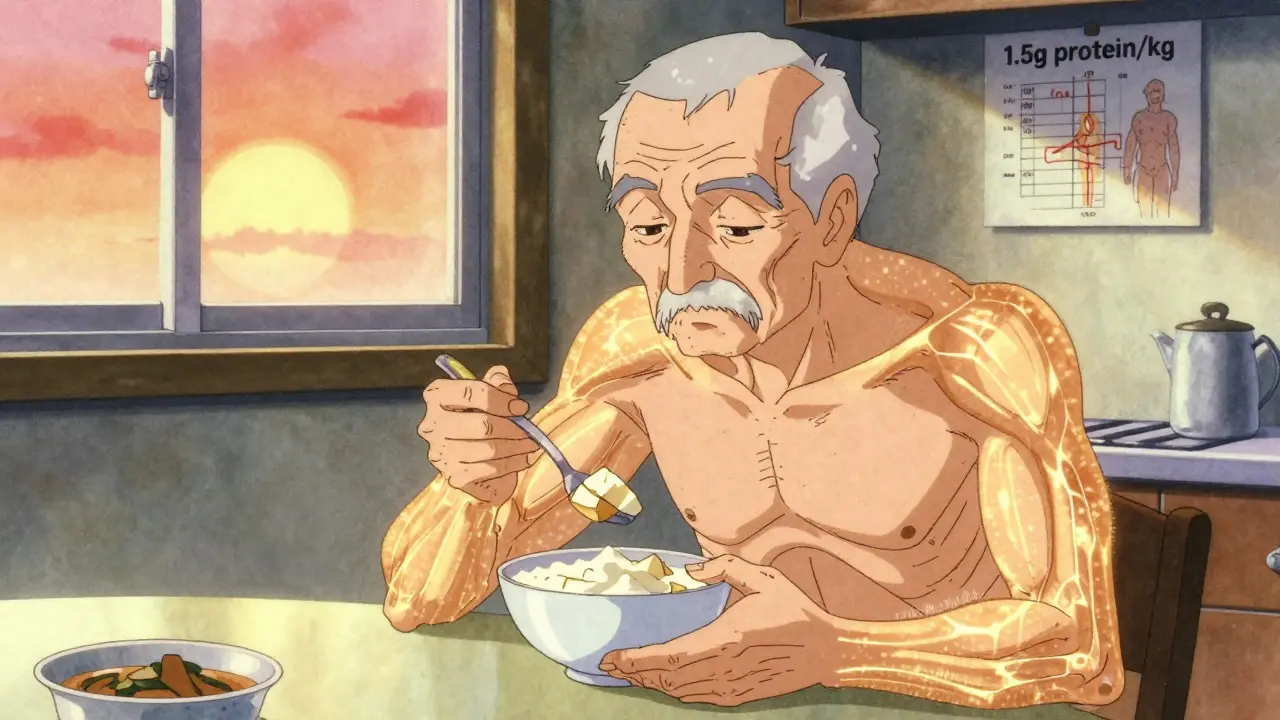
When your liver is damaged by cirrhosis, your body doesn’t just struggle to filter toxins - it starts breaking down its own muscle just to stay alive. This isn’t a slow decline. It’s a silent, accelerating loss of strength that increases your risk of death by two to three times. And the most powerful tool to fight it? Protein.
For decades, doctors told people with cirrhosis to cut back on protein. The logic was simple: less protein = less ammonia = less confusion. But that advice, once rooted in good intentions, was wrong. It made people weaker, sicker, and more likely to die. Today, we know better. The real danger isn’t too much protein - it’s not enough.
Why Protein Isn’t the Problem - It’s the Solution
Cirrhosis turns your body into a furnace. Even at rest, you burn through energy and muscle faster than someone with a healthy liver. Your liver can’t make proteins like albumin anymore. Your muscles start to shrink. This isn’t just about looking frail - it’s about surviving. Studies show that 40% to 70% of people with cirrhosis lose so much muscle that they develop sarcopenia. And sarcopenia? It’s not just weakness. It’s a death sentence. People with sarcopenia are up to 2.8 times more likely to die while waiting for a liver transplant.
For years, doctors thought reducing protein would help with hepatic encephalopathy (HE) - the confusion, forgetfulness, or even coma that can come with advanced liver disease. But a landmark 2004 study changed everything. Researchers gave one group of patients only 0.5 grams of protein per kilogram of body weight per day. Another group got 1.2 grams. The low-protein group didn’t get less confused. They just lost muscle faster. The high-protein group stayed stronger. No worse encephalopathy. Just better muscle.
Today, the American Association for the Study of Liver Diseases (AASLD) says protein restriction is harmful. Not unnecessary. Harmful. And they’re not alone. The British Liver Trust, the University of Michigan, and the Veterans Affairs Hepatitis Resource Center all agree: you need protein. Not less. More.
How Much Protein Do You Really Need?
It’s not one-size-fits-all. But the numbers are clear.
For most adults with stable cirrhosis: 1.2 to 1.5 grams of protein per kilogram of ideal body weight per day. That means if your ideal weight is 70 kg (about 154 lbs), you need 84 to 105 grams of protein daily. If you already have muscle loss, aim for the higher end - 1.5 grams.
For those who are sick, hospitalized, or recovering from infection: 1.2 to 2.0 grams per kilogram. That’s because illness makes your body burn even more muscle.
Here’s the catch: you can’t use your current weight if you have fluid retention. Cirrhosis causes swelling in the belly and legs - ascites and edema. That extra fluid adds weight, but it’s not muscle or fat. It’s water. So if you weigh 90 kg but have 10 kg of fluid, your dry weight is 80 kg. Use that number. Your dietitian can help you figure it out.
And don’t forget calories. You need fuel to use that protein. Aim for 35 kcal per kilogram of dry weight if your BMI is normal. If you’re overweight, you still need 25-35 kcal per kg. Your body doesn’t care if you’re carrying extra fat - it still needs energy to rebuild muscle.
Where to Get Your Protein - Not All Sources Are Equal
Not all protein is created equal - especially when your liver is struggling.
Meat, especially red meat, can be harder to digest and may trigger more ammonia. That’s why experts recommend focusing on plant-based and dairy proteins first.
- Dairy: Milk, yogurt, cottage cheese, low-salt cheese. An 8-ounce glass of milk has 8 grams of protein. A cup of Greek yogurt? Up to 20 grams.
- Plant-based: Lentils, beans, chickpeas, tofu, edamame, soy milk, oats, nuts, seeds. A half-cup of cooked lentils gives you 9 grams. A 3-ounce serving of tofu? Around 10 grams.
- Eggs: One large egg has 6 grams. Easy to digest. Great option.
- Lean meats: Chicken, fish, turkey - fine in moderation. A 3-ounce serving of chicken has 27 grams. But don’t make it your main source.
Many people with cirrhosis find they tolerate dairy and beans better than steak. That’s not a coincidence. Plant and dairy proteins have different amino acid profiles and produce less ammonia during digestion. The British Liver Trust says it plainly: “Take as much of your protein from vegetable sources as possible.”
Meal Timing Matters More Than You Think
It’s not just how much you eat - it’s when.
Your body goes into muscle-burning mode overnight. No food for 8 hours? Your liver can’t stop the breakdown. That’s why experts say: never fast longer than 3-4 hours during the day.
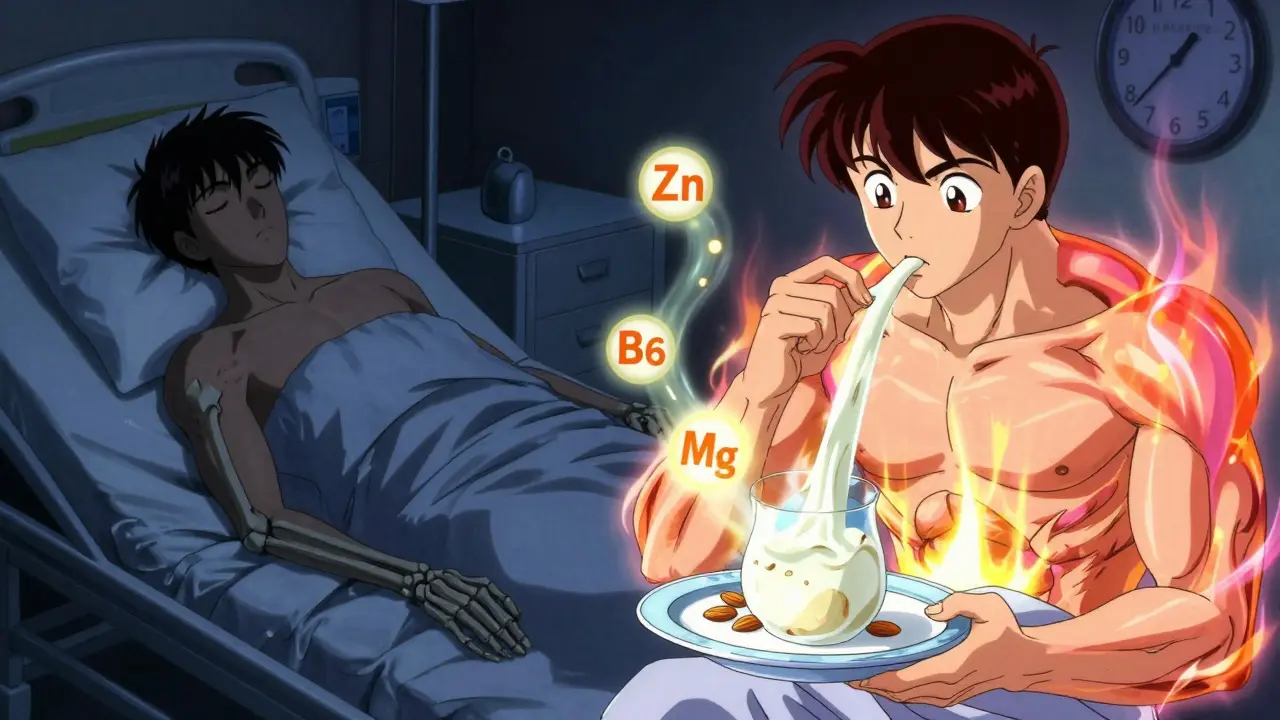
Instead of three big meals, aim for five or six smaller ones. Eat every 2 to 4 hours while you’re awake. And here’s the most important part: have a high-protein snack right before bed.
One study showed that a late-night snack with 30-40 grams of protein improved nitrogen balance - meaning your body stopped breaking down muscle and started rebuilding it. A cup of cottage cheese. A hard-boiled egg with whole-grain toast. A protein shake. Even a small handful of almonds and a glass of soy milk helps.
The VA Hepatitis Resource Center says it bluntly: “Overnight fasting is discouraged due to worsening of muscle depletion.” Don’t skip dinner. Don’t go to bed hungry. Your muscles need you to feed them.
What If You Can’t Eat Enough?
Loss of appetite, early fullness from fluid buildup, and taste changes are common. You might feel full after a few bites. That’s normal. But you still need the nutrients.
Focus on nutrient-dense foods. Choose whole milk over skim. Add peanut butter to toast. Eat dried fruit instead of juice. Use olive oil or butter on vegetables. Small changes add up.
If you’re struggling to hit your protein goals, talk to your doctor or dietitian about supplements. Some are specially designed for liver disease. Clif Builder’s Bars have 68 grams of protein per bar. Nature Valley Protein bars have 40 grams. These aren’t snacks - they’re medical tools.
Prescription supplements like Ensure Plus or Nepro HP can be lifesavers. They’re high in protein, calories, and often contain added zinc and B vitamins - nutrients that are often low in cirrhosis.
Micronutrients You Can’t Ignore
Protein is key, but it’s not the whole story.
Cirrhosis messes with how your body absorbs and uses vitamins and minerals. Common deficiencies include:
- Zinc: Helps with taste, immune function, and protein synthesis. Many people with cirrhosis are low. 50 mg of oral zinc daily is often recommended.
- Thiamine (B1), Niacin (B3), Pyridoxine (B6), Folate: These B vitamins help your body turn food into energy. Deficiency can make fatigue worse.
- Magnesium: Needed for muscle function. Low levels are common.
But be careful. Too much vitamin A or D can be toxic. Vitamin C can make iron overload worse in people with hemochromatosis. Always check with your doctor before taking supplements.
When Sodium Restrictions Clash With Nutrition
Many people with cirrhosis are told to cut salt to control fluid buildup. But if you’re so restricted that you can’t eat enough protein or calories, the trade-off isn’t worth it.
The AASLD says: “Liberalization of sodium restriction should be considered if a patient is unable to maintain nutritional targets.” That means if you’re losing weight and muscle because you’re too scared to salt your food, talk to your doctor. Maybe you need to eat more - even if it means a little more fluid retention. Your muscle matters more.
It’s not about going back to junk food. It’s about finding balance. A little salt on grilled chicken or beans? Better than skipping the meal.
The Bottom Line
Protein isn’t the enemy. Starvation is.
Cirrhosis doesn’t care how much fluid you have. It doesn’t care if you’re on a low-salt diet. It only cares if you have muscle left. And if you don’t, your chances of surviving - even with a transplant - drop dramatically.
So eat. Eat often. Eat protein from plants and dairy first. Have a snack before bed. Don’t let outdated advice keep you weak. You’re not just managing a disease - you’re fighting for your body. And protein? It’s your strongest weapon.
Should I avoid protein if I have hepatic encephalopathy?
No. Avoiding protein makes hepatic encephalopathy worse over time by accelerating muscle loss. Multiple studies, including a major 2004 trial, show that protein intake does not worsen confusion. In fact, patients who eat enough protein have better muscle mass, strength, and survival rates. Current guidelines from the American Association for the Study of Liver Diseases (AASLD) and the British Liver Trust recommend 1.2-1.5 grams of protein per kilogram of ideal body weight daily - even for those with encephalopathy.
How do I calculate my protein needs if I have fluid retention?
Use your ideal body weight (IBW) or dry weight - not your current weight. Fluid retention adds extra pounds that aren’t muscle or fat. To estimate IBW: for men, start with 50 kg and add 2.3 kg for every inch over 5 feet. For women, start with 45.5 kg and add 2.3 kg per inch over 5 feet. For example, a 5’10” man would have an IBW of about 70 kg. Multiply that by 1.2-1.5 to find your daily protein target. Your dietitian can help you adjust this based on your actual condition.
What are the best high-protein snacks for someone with cirrhosis?
Good options include: Greek yogurt (20g protein per cup), cottage cheese (14g per half-cup), hard-boiled eggs (6g each), tofu (10g per 3 oz), lentils (9g per half-cup cooked), soy milk (7g per cup), almonds (6g per ounce), and protein bars like Clif Builder’s (68g) or Nature Valley Protein (40g). For bedtime snacks, try a small bowl of cottage cheese with fruit, or a glass of soy milk with a tablespoon of peanut butter.
Can I eat red meat if I have cirrhosis?
Red meat can be included in moderation, but it’s not the best first choice. Animal proteins like beef and pork produce more ammonia during digestion, which can be harder for a damaged liver to process. It’s better to prioritize plant-based and dairy proteins - beans, lentils, tofu, eggs, yogurt, and milk - which are easier to tolerate and less likely to trigger symptoms. If you do eat red meat, stick to small portions (3 oz or less) and pair it with vegetables or whole grains to slow digestion.
Do I need to take supplements for cirrhosis?
Many people with cirrhosis benefit from supplements, especially zinc, B vitamins, and magnesium, since absorption is often poor. Zinc (50 mg daily) is commonly recommended. But don’t self-prescribe. Vitamin A and D can be toxic in excess, and vitamin C can worsen iron overload in some cases. Always talk to your doctor or dietitian before starting any supplement. Prescription medical nutrition formulas (like Nepro HP or Ensure Plus) are often better than over-the-counter options because they’re designed for liver disease and include balanced nutrients.



Man, this post hit different. I’ve been living with cirrhosis for 5 years now, and honestly? The idea that protein was the enemy was burned into my brain by doctors in the 90s. I cut back on eggs, dairy, beans-everything. Ended up so weak I could barely lift my grandkid. Then I found this study on Reddit and tried 1.4g/kg. Two months later? I walked 5K without stopping. My wife cried. Not because I lost weight-because I finally looked like myself again.
thank you for this. i’ve been scared to eat protein for years. now i’m gonna try greek yogurt before bed. 💛
Let’s be honest-the only reason this info is ‘new’ is because the medical establishment was too lazy to update their textbooks. I’ve been telling my patients for a decade: if your liver can’t handle protein, it’s because you’re underfeeding it. Protein restriction is a relic of 1970s dogma wrapped in a lab coat.
Protein restriction was a mistake. Full stop. The AMA should issue a formal apology. People are dying because doctors still believe this crap. I’ve seen it firsthand in VA hospitals. Weak patients. Failed transplants. All because someone thought reducing protein would help encephalopathy. It doesn’t. It kills. Period.
So I’ve been doing this for about 8 months now-5 small meals a day, bedtime cottage cheese, zero fasting. My ascites is still there, but my strength? Gone from ‘can’t get out of chair’ to ‘lifting weights with my nephew.’ I didn’t know muscle could come back this fast. Also, soy milk with peanut butter before bed? Game changer. I used to think that was just a hippie thing. Turns out it’s science. Who knew?
For those calculating dry weight-don’t guess. Ask your dietitian for a bioimpedance scan. It’s not perfect but it’s better than estimating IBW. Also, zinc supplementation helped my taste buds come back. I could actually enjoy food again after 2 years of bland everything.
Everyone talks about protein like it’s some magic bullet. But let’s not ignore the real issue-poor diet culture in the West. You eat processed crap, then you get cirrhosis, then you think protein bars will fix it? No. The problem is systemic. You don’t fix a broken liver with Clif Bars. You fix it by eating real food, quitting alcohol, and rejecting the fast-food-industrial complex. This post is a band-aid on a severed artery.
Protein isn’t just fuel-it’s a promise. A promise to your body that you haven’t given up. Every bite of tofu, every spoon of Greek yogurt, every egg before bed? It’s a whisper: ‘I’m still here. I’m still fighting.’ I used to cry when I couldn’t lift my own coffee mug. Now? I make breakfast for my daughter. That’s not nutrition. That’s redemption. 🙏✨
This is so important. I’m so glad someone finally broke this down. I’ve been telling my mom (who has cirrhosis) to eat more dairy and eggs for months. She kept saying ‘the doctor said no protein.’ I showed her this. She cried. Then she made a smoothie with soy milk, peanut butter, and a banana. First time she ate a full meal in weeks. Thank you. From the bottom of my heart.
Let me guess-this was written by someone who sells protein bars. Big Pharma doesn’t want you eating beans and eggs. They want you buying their $50 supplements. Wake up. Real food > branded powders. Also, why are we assuming everyone can afford Greek yogurt? Not everyone lives in a Whole Foods zip code.
OMG YES. I’ve been doing the bedtime snack thing for 3 months and my energy is UNREAL. I used to nap after dinner. Now I read novels. Also, I started adding a pinch of sea salt to my lentils. My fluid retention didn’t get worse. My strength did. Thank you thank you thank you 💕
Here’s the wild part: the body doesn’t care if you’re ‘eating clean.’ It only cares if you’re eating enough. I used to think ‘plant-based protein’ meant I had to eat kale and quinoa. Nope. I started eating peanut butter straight out of the jar with a spoon. 8 grams. Easy. 3 times a day. My wife thought I’d lost my mind. Now she does it too. Sometimes, the most ‘unhealthy’ thing you can do… is not eat.
Let’s be real-this is just another example of medical consensus being overturned because someone with a grant needed a headline. The 2004 study? Tiny sample size. No long-term follow-up. And yet here we are, turning protein into a gospel. Meanwhile, the real issue-gut dysbiosis, ammonia clearance, bile flow-is ignored. This is reductionist nonsense dressed as science.
One thing missing: the role of branched-chain amino acids (BCAAs). They’re not a magic bullet, but for some with HE, they can help maintain muscle without spiking ammonia. Not a replacement for whole protein, but a bridge. Also, if you’re on lactulose, you might need more sodium to avoid dehydration. Talk to your team.
India has been doing this right for centuries. Dal, paneer, yogurt, lentils-these are not ‘alternative’ foods. They’re ancestral. Western medicine only caught up because it finally stopped listening to its own arrogance. We didn’t need a 2004 study. We had grandmothers.