
Most headaches are harmless. You’ve had them before-stress, lack of sleep, dehydration-and they fade with rest or an ibuprofen. But sometimes, a headache isn’t just a headache. It’s your brain screaming for help. And if you miss the signs, the consequences can be permanent-or fatal.
When a Headache Is a Medical Emergency
Headaches are common. The World Health Organization says about half of all adults get one each year. But only about 5% of those visiting emergency rooms have something serious going on. That sounds low, until you realize that up to 20% of these cases are missed because doctors and patients alike ignore the warning signs.
The key isn’t how bad the pain is. It’s how it shows up. A headache that comes out of nowhere, like a lightning strike, is the biggest red flag. That’s called a thunderclap headache-peak pain in under a minute. Eighty-five percent of people with a ruptured brain aneurysm describe it exactly that way. One study found that if you wait even four hours to get checked, your risk of a second, deadly bleed goes up by 40%.
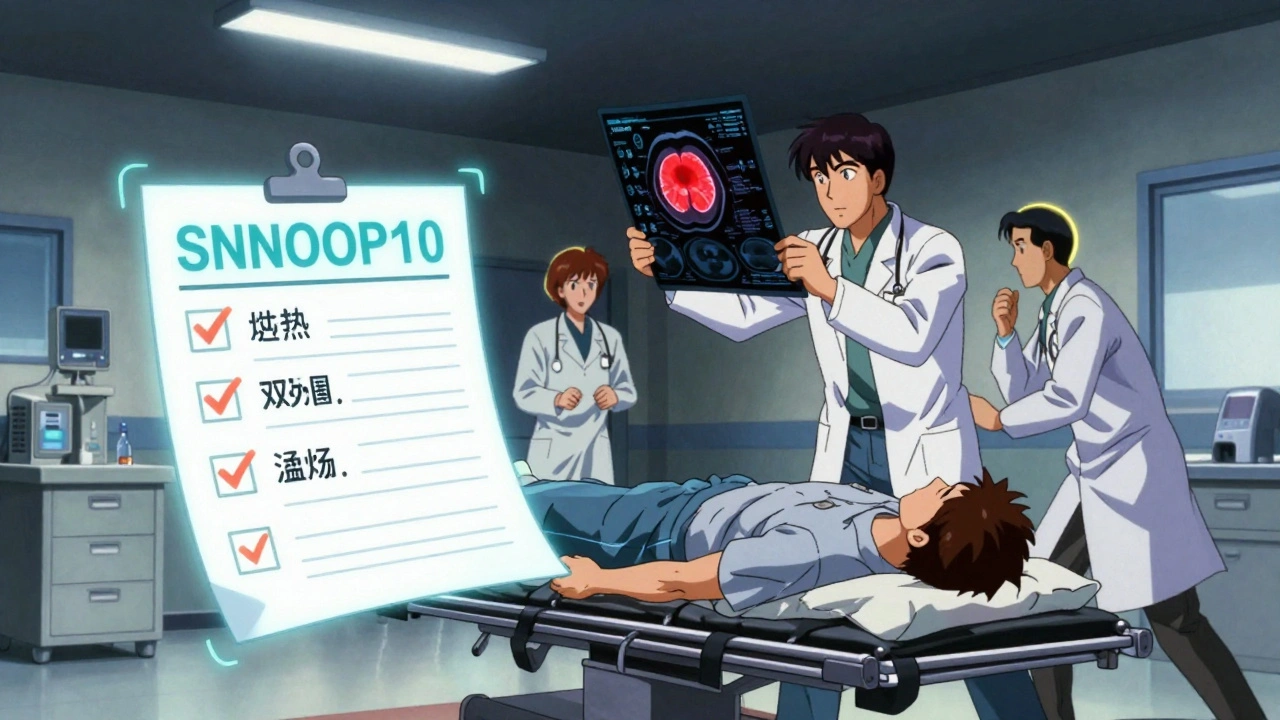
The SNNOOP10 Checklist: What Doctors Look For
Neurologists use a simple memory tool called SNNOOP10 to spot dangerous headaches. It’s not perfect, but it’s been tested on over 2,000 patients and works. Here’s what to watch for:
- Systemic symptoms: Fever, chills, weight loss. If you’re running a fever and your head feels like it’s splitting open, it could be meningitis.
- Neoplastic history: You’ve had cancer. A new headache now could mean the cancer has spread to your brain.
- New onset after age 50: If you’ve never had bad headaches before and suddenly you’re getting them at 52, it could be giant cell arteritis-a dangerous inflammation of blood vessels in your scalp and brain.
- Onset sudden: Again, thunderclap headache. No warning. Just pain so intense you collapse.
- Overall change in pattern: Your usual migraines are now worse, longer, or happening more often. That’s not normal.
- Positional: Pain gets worse when you lie down or stand up. Could mean pressure inside your skull is rising.
- Precipitated by Valsalva: Pain triggered by coughing, sneezing, or straining. Often linked to tumors or fluid buildup.
- Progressive: Headache gets steadily worse over days or weeks. Could be a slow-growing brain tumor.
- Papilledema: Swelling of the optic nerve, seen by an eye doctor. A clear sign of high pressure in the brain.
- Painful eye with autonomic features: Red eye, drooping eyelid, sweating on one side of the face. Could be a cluster headache or something more serious.
You don’t need all of these. One or two, especially if they’re new for you, should send you to the ER.
Neurological Symptoms: Don’t Wait
Here’s the easiest way to know when to act: if your headache comes with any neurological symptom, call 911. Not tomorrow. Not after you finish your work email. Now.
- Focal weakness: One arm or leg suddenly feels numb or weak. Could be a stroke.
- Slurred speech or trouble finding words. Not just mumbling-your brain is struggling to control language.
- Diplopia: Double vision. Not blurry. Two distinct images. That’s not a tired eye-it’s a nerve problem.
- Altered mental status: Confusion, drowsiness, not recognizing people. This is a major red flag for infection or bleeding.
- Seizure: Any new seizure with a headache? That’s an emergency.
These aren’t side effects. They’re signs your brain isn’t working right. The American Stroke Association says if you have a headache with weakness or speech trouble, you need to be seen within three hours. Every minute counts. Sixty-three percent of strokes present with headache as the first symptom.
Headache After Injury? Get Scanned
Hit your head? Even if you didn’t lose consciousness, a headache afterward can be dangerous. The rules are simple:
- Lost consciousness for more than five minutes? Get a CT scan now.
- Vomited more than twice? That’s a red flag.
- Headache getting worse over the next 24 hours? Don’t wait.
One Reddit user, ‘HeadacheSurvivor89,’ ignored their headache after a fall, thinking it was just a concussion. Four hours later, they were in surgery for a ruptured aneurysm. The delay increased their chance of dying by 40%.
Headaches Over 50? Think Giant Cell Arteritis
If you’re over 50 and suddenly get a pounding headache, especially with jaw pain when chewing or tenderness on your temples, don’t brush it off. It could be giant cell arteritis. This is an inflammation of arteries that supply blood to your head. If untreated, it can cause permanent blindness in hours.
The signs? Jaw claudication (pain when chewing), scalp tenderness, fatigue, and vision changes. Blood tests can help, but treatment with steroids must start within hours. The American College of Rheumatology says this condition is 23 times more likely after age 50. And it’s often mistaken for a migraine.
Fever + Headache + Stiff Neck? It’s Not Just the Flu
Feeling sick? Fever, headache, and neck stiffness together? That’s meningitis. Bacterial meningitis kills 17% of people who don’t get treatment fast. And for every hour you wait, your chance of dying goes up by 5.2%.
You don’t need a textbook case of neck stiffness. Even mild discomfort bending your neck forward, combined with fever and headache, is enough to warrant an ER visit. Doctors will do a spinal tap within two hours. Antibiotics start within 45 minutes. Delay that, and you risk brain damage or death.
What About Migraines? How to Tell the Difference
Migraines can be brutal. But they have a pattern. They usually build over 5 to 20 minutes. Aura-flashing lights, blind spots, tingling-comes before the pain and fades within an hour. The pain is often one-sided, throbbing, and worsens with movement. Nausea and light sensitivity are common.
Stroke symptoms? They come on fast. Within minutes. No warning. And they don’t fade. If you’ve had migraines your whole life and suddenly your aura lasts 90 minutes or you get weakness on one side? That’s not your usual migraine. That’s a stroke.
What Happens in the ER?
If you show up with a red flag headache, here’s what you’ll likely go through:
- Immediate triage-nurses use the SNOOP4 tool: Sudden onset, Neurologic symptoms, Onset after 50, Papilledema.
- Non-contrast CT scan within 30 minutes. This catches 98% of brain bleeds within six hours.
- If the CT is normal but suspicion is still high (like with thunderclap headache), you’ll get an MRI or lumbar puncture within four hours.
- If meningitis is suspected, antibiotics start before test results come back.
AI tools like HeadacheAI are now helping ER staff spot red flags faster. One study showed they were 89% accurate, compared to 76% for doctors. But no tool replaces your instincts-if something feels wrong, push for more tests.
Why People Wait-And Why That’s Deadly
A 2023 survey by the National Headache Foundation found that 63% of people with thunderclap headaches ignored them at first. They thought, “It’ll pass.” “I’m just stressed.” “I’ve had this before.”
One user on HealthUnlocked, ‘MigraineWarrior,’ had blurred vision and slurred speech. Her doctor said it was anxiety. She waited 3.5 hours. She had a stroke. She lost vision in one eye permanently.
On the flip side, ‘NeuroAlert’ on PatientsLikeMe noticed neck stiffness with fever and went straight to the ER. They had viral meningitis. Early treatment meant no long-term effects.
The difference? Awareness.
What You Can Do Today
You don’t need to be a doctor to save a life-yours or someone else’s.
- Know the red flags. Keep this list handy.
- If you have a headache with any neurological symptom-call 911. Don’t drive yourself.
- If you’re over 50 and get a new, severe headache, see your doctor within 24 hours.
- If you’ve had cancer and get a new headache, don’t wait. Get checked.
- Tell your family. Teach your kids. Red flags don’t care how old you are.
Most headaches are nothing. But the ones that are deadly don’t warn you twice. If you’re unsure, err on the side of caution. Your brain doesn’t have a backup.
Is a thunderclap headache always a brain aneurysm?
No, but it’s the most common sign of a ruptured aneurysm. Other causes include reversible cerebral vasoconstriction syndrome (RCVS), stroke, or severe high blood pressure. Still, any thunderclap headache needs immediate imaging-CT or MRI-to rule out life-threatening causes. Never assume it’s just a bad migraine.
Can a headache be a sign of a brain tumor?
Yes, but it’s rare. Brain tumors usually cause headaches that get worse over weeks or months, often worse in the morning or when lying down. They’re often accompanied by nausea, vomiting, vision changes, or seizures. If your headaches are new, progressively worse, and don’t respond to usual treatments, imaging is needed. The risk is about 1 in 200 for new-onset headaches in people over 50.
Should I go to the ER for a headache after a car accident?
Yes-if you have any of these: loss of consciousness, vomiting more than twice, worsening headache, confusion, or neurological symptoms like weakness or blurred vision. Even if you feel fine at first, internal bleeding can develop hours later. CT scans within an hour can catch most serious injuries.
Can stress cause a headache that mimics a stroke?
Stress can cause tension headaches or migraines, but it doesn’t cause stroke-like symptoms like sudden weakness, slurred speech, or vision loss. If you’re having those symptoms, it’s not stress-it’s neurological. Don’t dismiss them because you’ve been under pressure. Stroke doesn’t care how busy you are.
What if I have a headache and I’m immunocompromised?
Any headache if you’re immunocompromised-due to cancer, chemotherapy, organ transplant, or HIV-requires immediate evaluation. You’re at higher risk for fungal or viral meningitis, which can be fatal. Even without fever or neck stiffness, don’t wait. The mortality rate for fungal meningitis is 35% even with treatment. Early diagnosis saves lives.
What to Do Next
If you’ve ever brushed off a bad headache, this is your reminder: pay attention. Your brain doesn’t send warnings often-but when it does, listen. Keep this information where you can find it. Share it with loved ones. And if you or someone you know has a headache that feels wrong-don’t wait. Call 911. You might just save a life.


Biggest thing I learned? Thunderclap headaches aren't just bad migraines. I used to pop ibuprofen and wait it out. Now I know if it hits like a truck, you don't wait. I told my dad after reading this. He's 61 and had one last month. He went to the ER. Turned out to be RCVS. No aneurysm but they caught it. This post saved his life.
Let me break this down for the people still thinking ‘it’s just stress’ - you’re not a doctor, your Google search isn’t a neurologist, and your ‘I’ve had this before’ is literally how people die. That SNNOOP10 checklist? It’s not a suggestion. It’s a survival manual. If you’re over 50 and get a new headache, get scanned. If you’ve had cancer and your head hurts, get scanned. If you have a fever AND a headache AND your neck feels stiff - call 911. Not your mom. Not your friend. 911. I’ve seen three people die because they waited for ‘it to pass.’ Don’t be the fourth.
Wow. So now we’re supposed to panic every time someone gets a headache? This is why America’s healthcare system is broken - people are being trained to treat every minor symptom like a national emergency. I’ve had thunderclap headaches since college. They’re migraines with aura. I’ve had MRIs. Nothing. You don’t need to run to the ER every time your head hurts. You need to stop fearmongering and start teaching people to know their own bodies. Not every headache is a stroke. Not every pain is a tumor. Some of us have lived with this for decades and we’re not idiots.
Also, your ‘neurologists use SNNOOP10’ claim? That’s not a real clinical tool. It’s a Reddit meme with fancy acronyms. Stop pretending it’s gospel.
Okay but can we talk about how wild it is that people ignore jaw pain when chewing? Like, I had that for months and thought it was TMJ. Turns out it was giant cell arteritis. My vision almost went. I didn’t even connect it to the headaches. This is why we need to stop normalizing ‘just a headache.’ You’re not being dramatic - your body is screaming. And if you’re over 50? You’re not ‘getting older,’ you’re getting a ticking clock. Get checked. Please. I’m alive because I listened. You can be too.
Ugh. Another ‘go to the ER or die’ post. I’m sick of medical fear porn. I’ve had migraines since I was 12. I know my body. If I had a stroke I’d know. I don’t need a checklist to tell me when to panic. Also, why are we all supposed to be experts now? You’re not a doctor. Stop giving medical advice like it’s a TikTok trend. I’m not going to the ER because I sneezed and my head hurt. Grow up.
My cousin went to the ER after a fall. They found a slow bleed. He’s fine now. Just listen to your body. No drama.
Wait wait wait - I have to say this. I work in an ER. I’ve seen 7 cases of thunderclap headaches in the last 6 months. 5 of them were aneurysms. 2 were RCVS. All 7 came in because someone’s partner said ‘this isn’t right.’ Not the patient. The partner. You think you’re being tough by waiting? You’re being selfish. You’re risking your life AND the life of the people who love you. If your partner says ‘you need to go,’ GO. Don’t argue. Don’t say ‘I’m fine.’ Just go. I’ve held hands while people coded because they didn’t listen. Don’t be that person.
I’m crying. I’m just… crying. I ignored my headache after my mom passed. I thought it was grief. Turns out it was meningitis. I was in the ICU for 11 days. My husband had to sign my DNR because I wasn’t responding. I woke up with hearing loss. And I still feel guilty every day because I thought it was just ‘sadness.’ I’m sharing this because I don’t want anyone else to lose their hearing. Or their life. Or their future. Please. If you feel something’s off - don’t wait. Don’t rationalize. Don’t think you’re being strong. You’re not. You’re just scared. And I was too. But I didn’t listen. Don’t make my mistake.
THIS. THIS. THIS. 🙌 I’m a nurse and I’ve seen too many people brush this off. I’m sharing this with my entire family. My mom’s 68. My brother’s 42. My niece’s 19. We’re all saving this. If you’re reading this and you’ve ever had a headache that felt ‘wrong’ - you were right. Trust yourself. And if you love someone? Tell them this. Don’t wait for them to be in pain. Tell them now. 💙❤️🩺