
Ever wonder why your pharmacist hands you a generic version of a drug even though your doctor wrote a brand name on the script? Or why, in a different state, you might have to specifically ask for the cheaper version? It all comes down to a fragmented patchwork of state laws. Depending on where you live, your pharmacist is either legally required to switch your medication to a generic or simply allowed to do so if they think it's a good idea. This isn't just a clerical difference; it's a massive driver of how much you pay at the pharmacy counter and how the healthcare system manages costs.
To understand this, we first have to look at Mandatory Substitution is a regulatory framework where pharmacists are legally compelled to dispense a generic equivalent if one is available and appropriate, unless the prescriber explicitly forbids it. In these states, the default is always the generic. If you want the brand name, your doctor usually has to write a specific phrase like "Brand Medically Necessary" or "Dispense as Written" (DAW). Without those magic words, the pharmacist doesn't have a choice-they must substitute.
On the flip side, Permissive Substitution is a legal approach that authorizes pharmacists to substitute a generic drug for a brand-name one, but leaves the final decision to the pharmacist's professional discretion. In a permissive state, the pharmacist *can* give you the generic, but they aren't *forced* to. This creates a much more flexible environment, but it also means generic utilization rates tend to be lower because the "default" isn't set to the cheaper option.
The Core Differences in Practice
While the basic idea seems simple, the actual implementation varies wildly across the US. According to research published in JAMA Internal Medicine, the difference isn't just about whether a pharmacist "can" or "must" substitute. There are four big levers that states pull to control how generics move through the system:
- The Duty to Substitute: This is the mandatory vs. permissive split we just talked about.
- Notification: Does the pharmacist have to tell the patient they are switching the drug? 31 states and DC require this notification to be separate from the drug packaging.
- Consent: Do you have to say "yes" before they switch? Only 7 states and DC require explicit patient consent.
- Liability: Who is on the hook if something goes wrong? In 24 states, pharmacists aren't explicitly protected from liability when they make a substitution.
These rules create what researchers call a "substitution score." The more barriers a state puts in place-like requiring a patient's signature or a separate notification-the higher the score and the lower the rate of generic use. It's a subtle game of friction; every extra step required by law makes it less likely that a patient gets the cheaper drug.
| Feature | Mandatory Substitution | Permissive Substitution |
|---|---|---|
| Default Action | Must dispense generic if available | May dispense generic if preferred |
| Prescriber's Role | Must use "DAW" to prevent generic | May suggest generic, but not required |
| Generic Utilization | Generally higher | Generally lower |
| Cost to Patient | Typically lower (default to generic) | Variable (depends on pharmacist/patient) |
Why This Matters for Your Wallet
You might think, "Who cares? I'll just ask for the generic." But the data shows that humans rarely do that. When the law removes the need for a conversation, the numbers shift dramatically. Take simvastatin, a common cholesterol medication. A study found that in states with mandatory laws, about 48.7% of prescriptions were filled with generics six months after the patent expired. In permissive states? Only 30%.
The impact of consent is even more shocking. In states that don't require you to sign off on the switch, generic utilization for that same drug hit 98.1%. When consent was required, it plummeted to 32.1%. Why? Because most people don't know they need to ask, and pharmacists don't always bring it up. When the law makes the generic the default, the cost savings are automatic.
This has huge implications for government spending. The Congressional Budget Office once estimated that just a 1% increase in generic use could save Medicare Part D roughly $160 million a year. Since generics typically cost 80-85% less than brands, the regulatory approach of a state directly affects the financial health of its Medicaid programs.
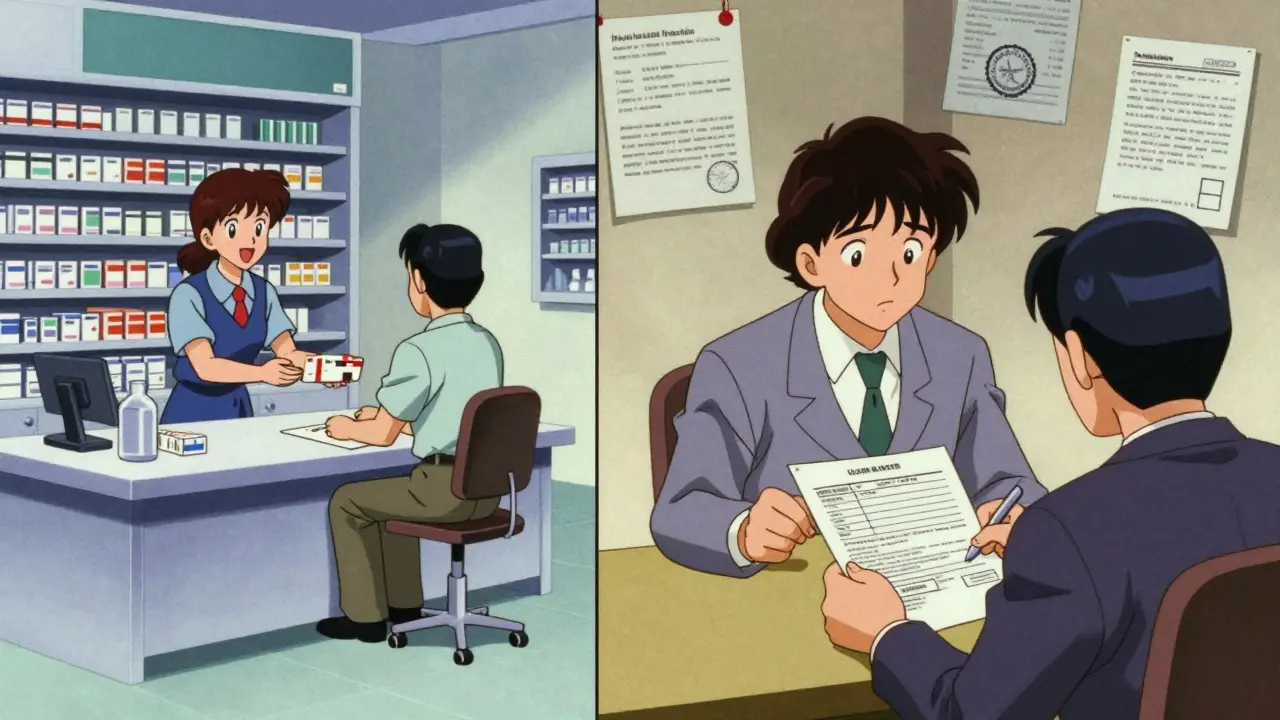
How Pharmacists Determine "Equivalence"
A pharmacist can't just swap any drug for any other. They need a source of truth. In most states, that source is The Orange Book, which is the FDA's official publication listing approved drug products with therapeutic equivalence evaluations (TEEs). If the FDA says two drugs are therapeutically equivalent, a pharmacist in a mandatory state will swap them without hesitation.
However, some states use their own systems called formularies. A "positive formulary" lists exactly which drugs are okay to swap, while a "negative formulary" lists the ones that are strictly off-limits. While the Orange Book is the gold standard, these state-level lists add another layer of complexity to the workflow.
The New Frontier: Biologics and Biosimilars
The rules we've discussed mostly apply to "small-molecule" drugs-the kind of pills you swallow. But we're now seeing a surge in Biologics, which are complex medications derived from living organisms, often injected, used for things like autoimmune diseases or cancer. These aren't as simple as generics. When a biologic's patent expires, we get Biosimilars, which are highly similar but not identical copies.
Because biologics are more expensive and potentially riskier, 45 states have much stricter rules for biosimilar substitution than they do for regular generics. The most common requirement is mandatory physician notification. In other words, the pharmacist can't just swap a biologic; they usually have to call the doctor first. This cautious approach reflects concerns about immunogenicity-the risk that a patient's immune system might react differently to a biosimilar.

Practical Challenges and Pitfalls
For the people on the ground, these laws create real friction. Pharmacists in mandatory states without consent requirements have a streamlined workflow, but they face a higher risk of patient confusion if the patient isn't expecting a different-looking pill. Meanwhile, pharmacists in permissive states must constantly exercise professional judgment, which can lead to inconsistency between different pharmacies in the same city.
Prescribers also have to be careful. For drugs with a "narrow therapeutic index"-where a tiny change in dose or formulation can be dangerous-substitution might be a bad idea. In these cases, doctors must be extremely precise with their "Dispense as Written" notations to ensure patient safety.
What is the difference between a generic and a biosimilar?
A generic is a chemical copy of a small-molecule drug, identical in active ingredient. A biosimilar is a "highly similar" version of a biologic drug. Because biologics are made from living cells, they can't be perfectly copied, which is why they are called biosimilars instead of generics and often face stricter substitution laws.
Can my doctor stop the pharmacist from substituting a generic?
Yes. Regardless of whether a state is mandatory or permissive, a prescriber can use a "Dispense as Written" (DAW) notation. In mandatory states, they may need to specify that the brand is "medically necessary" to override the default generic requirement.
Why do some states require patient consent for substitution?
Consent requirements are usually intended to protect patients from unexpected changes in their medication, which can cause anxiety or confusion. However, data shows that these requirements significantly lower the rate of generic use and increase overall healthcare costs.
Which is better for the patient: mandatory or permissive substitution?
From a cost perspective, mandatory substitution is generally better because it makes the cheaper generic the default. From a control perspective, permissive substitution allows for more professional discretion and patient choice, though this often results in higher out-of-pocket costs.
What happens if a pharmacist makes a mistake during substitution?
Liability varies by state. In some regions, laws explicitly protect pharmacists from increased liability when they substitute a generic. In 24 other states, no such explicit protection exists, meaning the pharmacist could be held responsible if an adverse event occurs following a substitution.
Next Steps and Troubleshooting
If you are a patient trying to save money, don't assume the law is doing the work for you. If you live in a permissive state, explicitly ask your pharmacist: "Is there a therapeutically equivalent generic for this?"
If you're a prescriber, be mindful of the state your patient lives in. If you are practicing in a mandatory state, remember that unless you specify "Brand Medically Necessary," your patient will likely receive a generic. If the drug has a narrow therapeutic index, be explicit in your instructions to avoid any risk of incorrect substitution.
For those managing pharmacy workflows, the best way to handle the fragmentation is to maintain a clear internal guide that maps your state's specific notification and consent requirements. This prevents legal slip-ups and ensures that patient notification is handled consistently, whether the law requires it or not.