
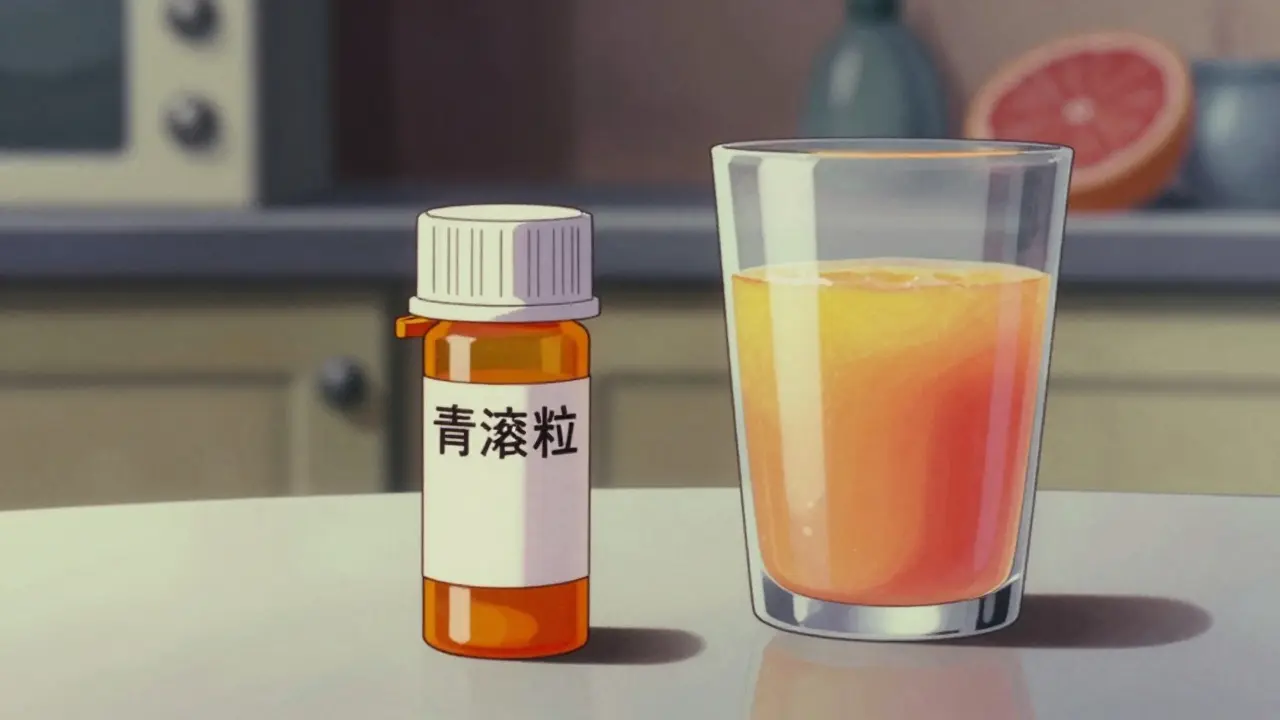
You've probably seen a warning label on a prescription bottle telling you to avoid grapefruit. To some, it sounds like a strange dietary restriction-why would a piece of fruit interfere with a life-saving pill? The answer lies in a complex family of proteins in your liver and gut called the Cytochrome P450 is a group of enzymes responsible for metabolizing about 75% of all clinically used drugs. When these enzymes are blocked, medication levels in your blood can spike to dangerous levels, turning a therapeutic dose into a potential overdose.
The "Grapefruit Effect": Why Timing Doesn't Matter
Most people assume that if they take their medication in the morning and drink grapefruit juice in the evening, they're safe. Unfortunately, that's not how it works. Grapefruit contains furanocoumarins is natural compounds, such as bergamottin, that irreversibly inhibit enzymes in the intestinal wall.
Specifically, these compounds attack CYP3A4 is the most abundant CYP450 enzyme in the human liver and intestine, handling the breakdown of a vast array of medications. Unlike a competitive interaction where two substances fight for the same spot, furanocoumarins essentially "break" the enzyme. Your body then has to synthesize entirely new proteins to replace the destroyed ones, a process that can take 24 to 72 hours. This is why a single glass of juice can keep your drug levels elevated for days.
Warfarin and the Blood-Thinning Tightrope
When it comes to Warfarin is a narrow therapeutic index anticoagulant used to prevent blood clots and strokes., the margin for error is tiny. If the drug level is too low, you risk a stroke; if it's too high, you risk internal bleeding. Warfarin is primarily broken down by CYP2C9 is the primary enzyme responsible for the metabolism of S-warfarin, the more potent isomer of the drug.
While grapefruit is most famous for hitting CYP3A4, research shows it also hampers CYP2C9. For most people, the interaction is "moderate," meaning you might see a slight increase in your INR (International Normalized Ratio) values. However, if you have a specific genetic makeup-specifically the CYP2C9*2 or *3 polymorphisms-your risk jumps. In these cases, grapefruit can push your blood-thinning levels into a danger zone. This is why genetic testing, which usually costs between $250 and $400, is becoming a tool for doctors to decide how strict a patient's diet needs to be.
| Medication | Primary Enzyme | Risk Level | Potential Effect |
|---|---|---|---|
| Warfarin | CYP2C9 / CYP3A4 | Moderate | Increased INR / Bleeding Risk |
| Sertraline | CYP3A4 / CYP2C19 | Low to Moderate | Increased Plasma Levels |
| Fluoxetine | CYP2D6 | Low | Minor Pharmacokinetic Shift |
| Escitalopram | CYP3A4 / CYP2C19 | Very Low | Negligible Clinical Change |
SSRIs: Not All Antidepressants Are Equal
If you're taking SSRIs is Selective Serotonin Reuptake Inhibitors, a class of antidepressants that increase serotonin levels in the brain., you might be wondering if you need to ditch the grapefruit. The answer depends entirely on which specific drug you're on. Because different SSRIs use different "exit doors" (enzymes) to leave your body, their risk levels vary.
- Sertraline (Zoloft): This one is more susceptible. Because it relies partly on CYP3A4, chronic grapefruit consumption has been linked to a 27-39% increase in drug concentration. You might feel more drowsy or nauseous.
- Fluoxetine (Prozac) and Paroxetine (Paxil): These primarily use CYP2D6 is an enzyme involved in the metabolism of many psychotropic drugs and opioids. While grapefruit does affect this enzyme, the impact is weak. Most people won't notice a clinical difference.
- Escitalopram (Lexapro): Recent studies in 2024 suggest almost no clinically significant interaction with grapefruit juice, making it one of the safer options for fruit lovers.
Hidden Traps: Varieties and "Health" Trends
Not all grapefruit is created equal. If you've switched to fancy hybrids like 'Oroblanco' or 'Sweetie' because they taste sweeter, be careful. New data suggests these varieties can have up to 300% more furanocoumarins than the traditional white or pink grapefruit. More furanocoumarins mean a more aggressive shutdown of your CYP450 enzymes.
We're also seeing a trend where health-conscious people are increasing their citrus intake. While antioxidants are great, the additive effect of multiple medications (polypharmacy) in aging populations means more people are accidentally triggering these interactions. If you're taking a cocktail of a blood thinner, a statin, and an antidepressant, a simple morning smoothie could potentially disrupt three different metabolic pathways at once.
Practical Safety Checklist
If you're unsure about your current regimen, use this rule of thumb to evaluate your risk:
- Check the "Narrow Therapeutic Index": Does your drug have a tiny window between "working" and "toxic"? (Example: Warfarin = Yes; Escitalopram = No).
- Verify the Enzyme: Does the drug rely on CYP3A4? If yes, grapefruit is a high-risk factor.
- Assess Bioavailability: Drugs with low oral bioavailability (under 50%), like sertraline, are often more sensitive to intestinal enzyme inhibition.
- Consider Genetics: If you have a history of reacting strongly to medications, you might be a "slow metabolizer" due to CYP2C9 or CYP2D6 variants.
Can I just eat a small amount of grapefruit?
For most people on SSRIs, a small amount is likely fine. However, for Warfarin users-especially those with genetic polymorphisms-even small amounts can lead to INR fluctuations. It's best to maintain a consistent diet rather than alternating between no grapefruit and occasional treats, as consistency helps doctors stabilize your dose.
Does grapefruit juice affect all antidepressants?
No. It primarily affects those metabolized by CYP3A4. While sertraline has some interaction, others like escitalopram show very little to no clinical interaction. Always check your specific medication's prescribing information.
If I stop eating grapefruit, how long until the enzymes recover?
Because furanocoumarins cause irreversible inhibition, your body must build new enzymes. This typically takes between 24 and 72 hours, though in some cases, it can take up to a week to fully return to baseline metabolic activity.
Are other citrus fruits like oranges safe?
Most sweet oranges are safe. However, Seville oranges (often used in marmalades) and pomelos contain similar furanocoumarins and can cause the same inhibitory effects on CYP3A4.
Why does the FDA warn about some SSRIs but not others?
The FDA bases warnings on the evidence hierarchy. For drugs like sertraline or trazodone, there's enough data to show a meaningful increase in plasma levels. For others, the metabolic pathway is different enough that grapefruit simply doesn't interfere with the drug's clearance.




The intersection of genetics and pharmacology is where true understanding begins. Most people just follow labels without realizing that their own CYP2C9 polymorphism is the real variable here. It's a classic case of biological determinism masking as dietary advice. The real tragedy is that we treat the average instead of the individual.