

Steroid Risk Assessment Tool
Assess Your Risk of Steroid-Induced Psychosis
This tool estimates your risk based on scientific evidence from medical studies. It's not a medical diagnosis, but can help you recognize warning signs and discuss your risk with your doctor.
When you’re prescribed corticosteroids for asthma, rheumatoid arthritis, or a flare-up of an autoimmune condition, you’re usually focused on the physical relief-less swelling, easier breathing, less joint pain. But there’s another side to these powerful drugs that rarely gets talked about until it’s too late: psychosis and dramatic mood shifts. It’s not rare. It’s not just "being moody." And it can happen to anyone, even if they’ve never had a mental health issue before.
It’s More Common Than You Think
About 10 million people in the U.S. get a new prescription for oral corticosteroids every year. That’s a lot of people taking prednisone, methylprednisolone, or dexamethasone. And between 5% and 18% of them will develop psychiatric symptoms. That’s roughly one in every six to twenty people. At doses above 40 mg of prednisone per day, the risk jumps to nearly 1 in 5. These aren’t outliers. These are real patients-your neighbor, your parent, your sibling-who suddenly become unrecognizable.What Does Steroid-Induced Psychosis Look Like?
It doesn’t always start with hearing voices or believing you’re the president. Often, it begins subtly:- Insomnia you can’t explain, even when you’re exhausted
- Uncharacteristic irritability-snapping at loved ones over small things
- Feeling unusually euphoric, almost giddy, without reason
- Confusion or trouble remembering simple things, like where you put your keys
- Suddenly feeling deeply depressed, hopeless, or worthless
- Delusions-believing someone is spying on you, or that you have a special mission
- Hallucinations-seeing shadows move, hearing voices no one else hears
- Disorganized speech-jumping between unrelated topics, talking in circles
- Agitation or aggression-pacing, yelling, or even becoming physically combative
Who’s Most at Risk?
It’s not random. Certain people are far more likely to experience these effects:- Women-multiple studies show women are more susceptible than men
- People over 65-aging brains are more sensitive to hormonal changes
- Those with a history of bipolar disorder or depression-even if it’s in remission
- Anyone on high doses for a long time-especially above 40 mg of prednisone daily

Why Does This Happen?
We don’t have all the answers, but we know enough to be alarmed. Corticosteroids don’t just reduce inflammation-they flood your brain with synthetic versions of cortisol, your body’s natural stress hormone. This disrupts multiple systems:- HPA axis suppression-your brain’s natural stress-response system gets turned off, then struggles to restart
- Hippocampal impact-the part of your brain responsible for memory and emotional regulation shrinks slightly under prolonged exposure
- Dopamine surge-animal studies show corticosteroids trigger increased dopamine production, which is directly linked to psychosis
What Should You Do If You Notice Changes?
If you or someone you care about is on corticosteroids and starts acting strangely, don’t wait. Don’t assume it’s stress or aging. Don’t blame them. Act.- Call the prescribing doctor immediately-especially if symptoms started within the first week
- Don’t stop the medication cold-sudden withdrawal can cause adrenal crisis, which is life-threatening
- Document the changes-write down what happened, when, and how long it lasted. This helps the doctor distinguish between steroid effects and other causes
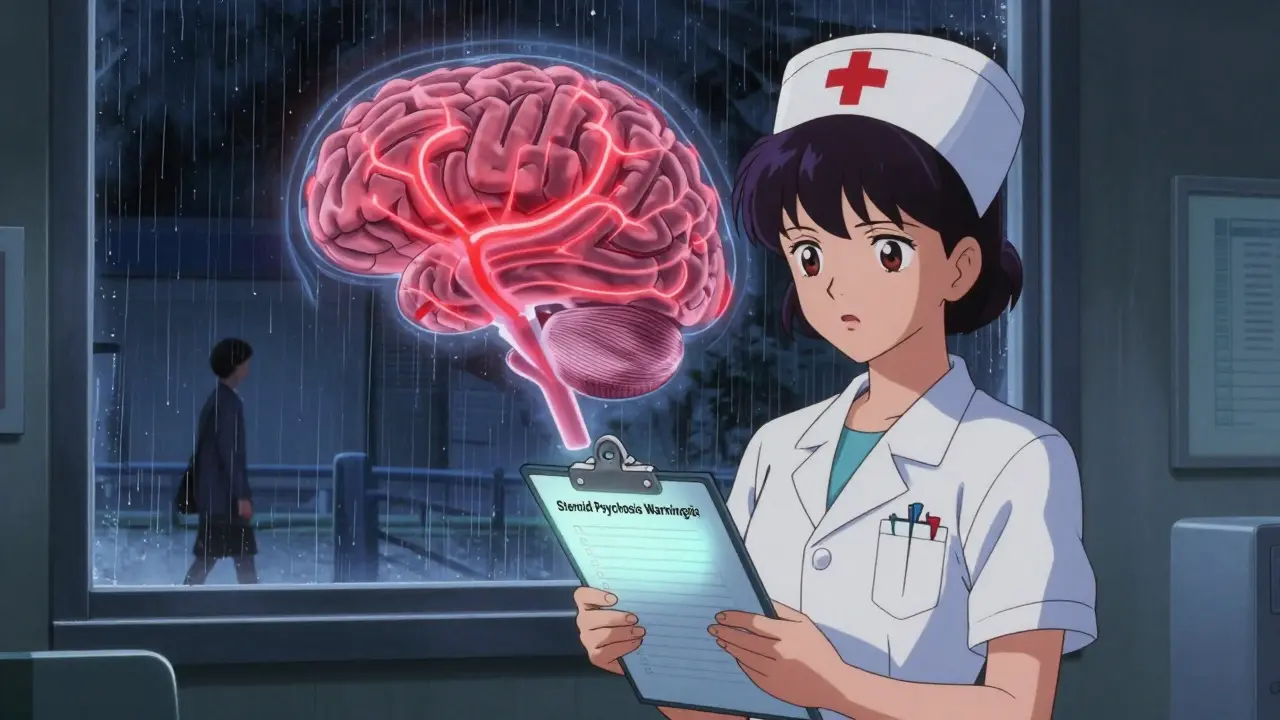
How Is It Treated?
There’s no FDA-approved drug specifically for this. But doctors have ways to manage it:- Tapering the dose-the most effective step. Reducing prednisone below 40 mg/day helps 92% of patients recover fully
- Low-dose antipsychotics-medications like haloperidol, risperidone, or olanzapine can calm psychotic symptoms within days
- Lithium-sometimes used to prevent mania, but it’s risky and requires close monitoring
What’s Missing in Healthcare?
Here’s the uncomfortable truth: we’re flying blind. There are no standardized screening tools for steroid-induced psychiatric effects. No blood test. No brain scan. No checklist doctors routinely use. Patients are often discharged from the hospital with a new steroid prescription and no warning about these risks. Pharmacists, nurses, and primary care providers need better training. Families need to know what to watch for. And patients need to be told, plainly: "This drug can change how you think and feel. If it does, tell someone right away." The pharmaceutical industry hasn’t developed a solution. Regulatory agencies haven’t mandated warnings strong enough. And clinicians still treat this as a rare curiosity, not the common, dangerous side effect it is.What You Can Do Right Now
If you’re taking corticosteroids:- Ask your doctor: "What are the mental health risks?" Don’t let them brush you off.
- Give a copy of this information to a family member or caregiver.
- Set a daily reminder to check in with yourself: "Am I feeling more anxious, irritable, or confused than usual?"
- Keep a mood journal-even just a few lines a day helps track patterns.
- Pay attention to sudden personality shifts.
- Don’t dismiss unusual behavior as "just being tired."
- If they seem lost, paranoid, or disconnected from reality, seek help immediately.
Can corticosteroids cause psychosis even at low doses?
Yes, though it’s rare. Most cases occur at doses above 40 mg of prednisone daily. But there are documented cases of psychosis at lower doses, especially in older adults or those with prior psychiatric conditions. No dose is completely risk-free.
How long do steroid-induced psychotic symptoms last?
In most cases, symptoms begin to improve within days of reducing the steroid dose and resolve fully within weeks. But in about 10-15% of cases, symptoms persist for months after stopping the medication. This suggests corticosteroids can cause lasting changes in brain chemistry, even after the drug is gone.
Are women really more likely to get steroid psychosis?
Yes. Multiple clinical studies show women are at higher risk than men, regardless of age or dose. The exact reason isn’t clear, but it may involve hormonal interactions between estrogen and cortisol pathways in the brain.
Can I still take corticosteroids if I’ve had depression before?
You can, but you need to be monitored closely. A history of depression or bipolar disorder significantly increases your risk of steroid-induced psychosis or mania. Your doctor should consider lower doses, shorter courses, or preventive psychiatric support before starting treatment.
Is there a blood test to detect steroid psychosis?
No. There’s no lab test or imaging scan that can diagnose steroid-induced psychosis. It’s a clinical diagnosis made by ruling out other causes-like infections, drug interactions, or brain tumors-and linking symptoms directly to steroid use. That’s why awareness and communication are critical.
What should I do if my doctor dismisses my concerns?
Get a second opinion. If you’re experiencing mood swings, confusion, or hallucinations while on steroids, your symptoms are real and urgent. Ask to speak with a psychiatrist or go to an emergency department. Delaying care can lead to hospitalization, self-harm, or irreversible damage to relationships and mental health.





Just had a patient on 60mg prednisone for 3 weeks develop full-blown delusions about aliens controlling her microwave. She was convinced the toaster was sending signals to her brain. Doctor thought she was "just stressed." Took 10 days after tapering to stabilize. This isn't rare. It's systemic.
Man, I've seen this so many times in ER. Patient comes in screaming about "the government bugging their teeth" - turns out they got a 5-day medrol pack for a bad sinus infection. No history of psychosis. No drugs. Just steroids. We start tapering, give them a tiny bit of risperidone, and boom - they're back to normal by day 4. Why aren't we screening for this like we do for DVTs? It's insane.
My mom went from sweet grandma to yelling at the TV like it was a cult leader after her RA flare-up. We thought she was having dementia. Turned out it was 20mg prednisone. Took 6 weeks after stopping for her to stop thinking the cat was spying on her. Doctors never warned us. I'm so pissed.
So let me get this straight - we pump synthetic cortisol into people like it's energy drink, then act shocked when their brain short-circuits? We're basically doing neurochemical Russian roulette and calling it medicine. And the pharma companies? They're too busy counting cash to care. Classic.
My bro was on steroids after a transplant and started talking to his reflection like it was his dead dad. We took him to the hospital and they were like "oh that's normal" and gave him a Xanax. He was 28. No mental health history. Just steroids. Don't let them gaslight you. Fight for your brain.
Wow, this is so basic. Anyone with a brain knows steroids mess with dopamine. I read a paper in JAMA Neuro last year showing hippocampal atrophy in 80% of patients on >40mg for >2 weeks. But no, let's just keep prescribing like it's Advil. The medical system is a joke. I'm a neurologist. I've seen it. You're all just late to the party.
Yea ok so steroids cause psychosis… big surprise. I mean, duh. Cortisol is literally the stress hormone. You flood the system, you get chaos. But here’s the real problem - docs don’t even know how to taper right. I had a friend who got pulled off cold and went into adrenal crisis. So now we got psychosis AND organ failure. Thanks, medicine.
Everyone knows this. But no one talks because it's cheaper to blame the patient. "You're just crazy." "You need therapy." Meanwhile, the pill bottle says "take daily." They don't say "this might make you believe your toaster is the CIA."
This made me cry 😭 I didn't know I wasn't alone. My sister went through this last year and we thought she was losing it. She's doing way better now, but it took 3 months. Please, if you're on steroids, tell someone. You're not broken. The drug is.
There's a philosophical layer here too. We treat the body as a machine - fix the inflammation, ignore the mind. But the brain isn't a separate system. It's the control center. When you flood it with synthetic hormones, you're not just changing mood - you're altering identity. That's not medicine. That's bioengineering without consent.
Thank you for writing this. My aunt had steroid psychosis after a kidney transplant. She thought her husband was an imposter. The doctors didn't connect it until she was hospitalized. She’s fine now, but it took 8 months. We need more awareness. This should be standard patient education.
Are you aware that this is part of a larger agenda? The pharmaceutical-industrial complex deliberately suppresses data on psychiatric side effects because antipsychotics are more profitable than steroid alternatives. The WHO has known since 2017. The FDA has been lobbied into silence. This isn't medical negligence - it's calculated exploitation. Wake up.