
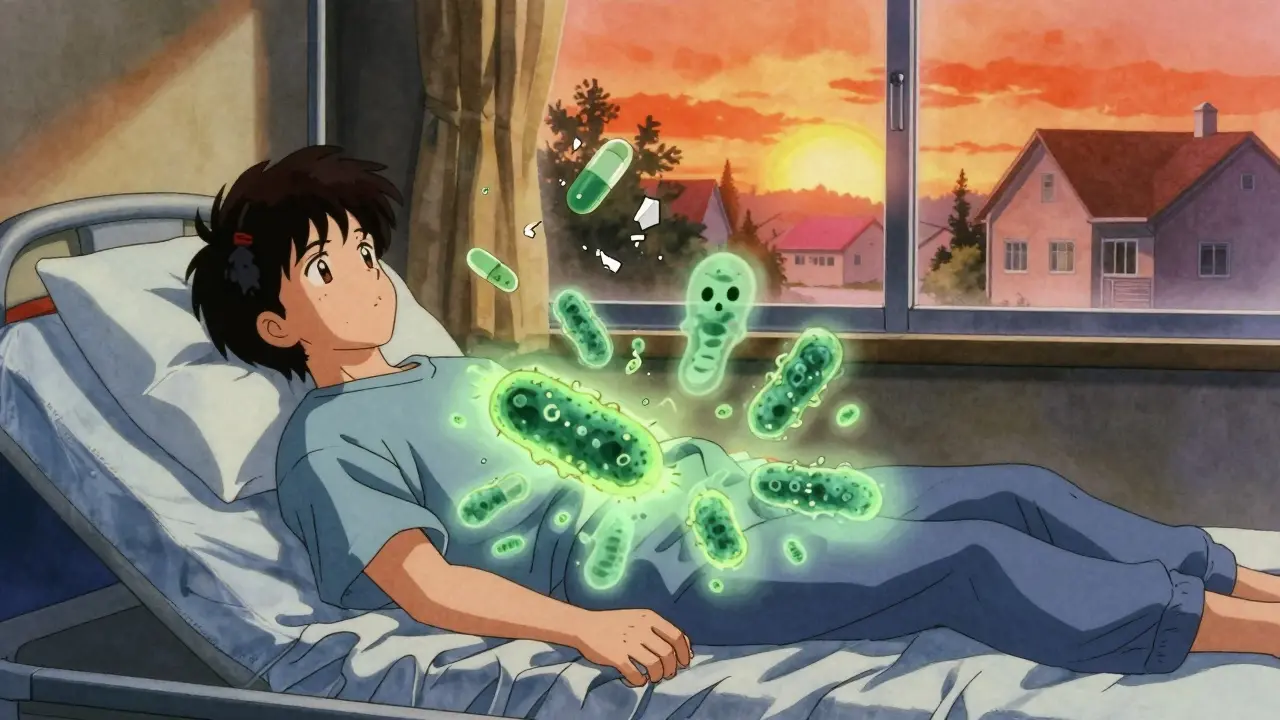
Every year, hundreds of thousands of people in the U.S. get sick from something most doctors never expect: a simple course of antibiotics. It’s not an allergic reaction or a side effect you read about on a pill bottle. It’s C. difficile colitis - a dangerous infection that turns your gut against you. And the weirdest part? The cure isn’t another drug. It’s poop.
What Exactly Is C. diff Colitis?
Clostridioides difficile - or C. diff - is a bacteria that lives quietly in some people’s intestines without causing harm. But when antibiotics wipe out the good bacteria that normally keep it in check, C. diff takes over. It multiplies fast, releases toxins, and attacks the colon lining. The result? Severe diarrhea, cramping, fever, and in worst cases, a ruptured colon or sepsis.
This isn’t rare. The CDC calls it an "urgent threat." In 2015 alone, there were over 500,000 infections in the U.S., and nearly 30,000 people died. Most of those cases started in hospitals, but now more than half happen in the community - people who never set foot in a clinic. The trigger? Antibiotics. Any kind. But some are far worse than others.
Which Antibiotics Are the Worst?
Not all antibiotics are created equal when it comes to C. diff risk. A 2023 study of over 33,000 hospital stays found that certain drugs double your chance of getting infected. The biggest offenders?
- Piperacillin-tazobactam (a type of penicillin combo) - highest risk, with a 2.18x increase
- Carbapenems - used for serious infections, but they clear out gut bacteria like a bulldozer
- Later-generation cephalosporins - especially ceftriaxone and cefepime
- Clindamycin - notorious for triggering C. diff, even in outpatient settings
On the flip side, tetracyclines (like doxycycline) carry the lowest risk. That doesn’t mean they’re safe - just less dangerous. The real danger isn’t just which drug you take, but how long you take it. Each extra day on antibiotics increases your risk by 8%. After 14 days, the risk spikes again - like a second wave hitting.
And here’s the kicker: if you’re already carrying C. diff without symptoms, antibiotics won’t make you sicker - you’re already at risk. But if you’re not carrying it, every antibiotic you take is a gamble. The CDC says it bluntly: "Any time antibiotics are used, they can cause side effects, including C. diff infection."
Why Do Antibiotics Cause This?
Your gut isn’t just a tube for digestion. It’s a bustling city of trillions of bacteria - good ones that help digest food, train your immune system, and block bad invaders. When you take antibiotics, especially broad-spectrum ones, you don’t just kill the bad bugs. You wipe out entire neighborhoods of helpful microbes. C. diff, which has spores that survive antibiotics, waits in the shadows. Once the good bacteria are gone, it wakes up, multiplies, and releases toxins that burn holes in your colon lining.
It’s not just about the drug. It’s about timing. People who get C. diff within 30 days of taking antibiotics are nearly five times more likely to have been exposed than those who weren’t. And once you’ve had one infection, your chances of getting another jump dramatically. About 20% of people get it again after treatment. For 1 in 5 of those, it comes back three or more times.
The Fecal Transplant Breakthrough
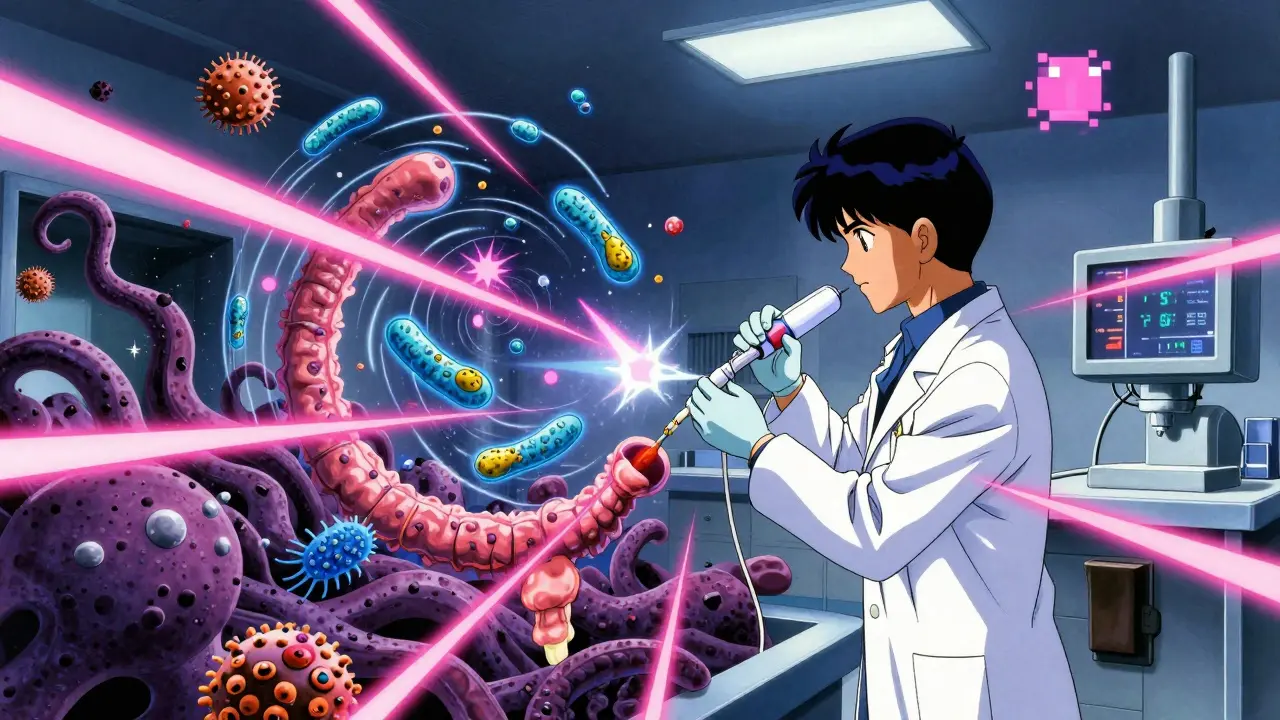
When standard treatments fail - and they often do - doctors turn to something that sounds like science fiction: fecal microbiota transplantation, or FMT. You read that right. They take stool from a healthy donor, process it into a liquid, and put it into the patient’s colon.
The first major study, published in the New England Journal of Medicine in 2013, showed shocking results. Of patients with recurrent C. diff, 94% were cured after one or two FMT treatments. Compare that to vancomycin, the standard antibiotic at the time: only 31% got better. That’s not a small difference. That’s a revolution.
Today, FMT works in 85% to 90% of cases for people with three or more recurrences. It’s not magic. It’s biology. You’re not just treating infection - you’re rebuilding the ecosystem. The healthy donor’s gut bacteria crowd out C. diff, restore balance, and help your immune system reset.
Delivery methods vary. Most often, it’s done via colonoscopy (65% of cases). Some use enemas (20%), or oral capsules (15%) - frozen pills you swallow that release the material in your intestines. The capsules are easier, less invasive, and increasingly common.
How Safe Is Fecal Transplant?
It sounds scary. But the risks are carefully managed. Donors are screened for everything: hepatitis, HIV, parasites, even rare genetic conditions. The FDA requires strict testing. In 2022, the FDA approved the first commercial FMT product, Rebyota, made from screened human stool. In 2023, Vonjo followed. These aren’t DIY procedures anymore - they’re regulated medicines.
Still, there are risks. A few cases of drug-resistant infections have been reported after FMT. One patient got a multi-drug-resistant E. coli from a donor - and died. That’s why screening is now tighter than ever. Long-term effects? We don’t know yet. Could FMT change your metabolism? Raise your risk for allergies or autoimmune diseases? Researchers are watching.
For now, the benefits outweigh the risks - especially for people who’ve had multiple relapses. One Reddit user wrote: "I had four recurrences. Vancomycin didn’t touch it. FMT? Gone in a week. I feel like I got my life back."
What About Probiotics or Other Alternatives?
Many people ask: Can’t I just take a probiotic? The short answer? No. The IDSA and CDC say there’s no solid proof that probiotics prevent C. diff. In fact, some studies show they might even harm immunocompromised people by causing bloodstream infections.
Some clinics have tried "staggered antibiotic withdrawal" with kefir - a fermented probiotic drink. A small study suggested it helped, but it’s not backed by large trials. The truth? For most people, stopping the offending antibiotic and letting the body heal naturally isn’t enough. C. diff is too stubborn.
There are new options. Bezlotoxumab - a monoclonal antibody that blocks C. diff’s main toxin - reduces recurrence by 10% when given with antibiotics. It’s expensive ($3,700 per dose) but used for high-risk patients. And in 2022, SER-109, a pill made of purified bacterial spores, showed 88% effectiveness in trials. It’s not a poop transplant - it’s a targeted microbiome therapy. FDA approval is expected soon.
Prevention Is the Real Solution
The best way to beat C. diff? Don’t get it in the first place.
- Ask: "Do I really need this antibiotic?" Many infections - like sinusitis or bronchitis - are viral. Antibiotics won’t help.
- If you do need one, ask if a lower-risk option exists. Tetracyclines or narrow-spectrum drugs might work just as well.
- Don’t take antibiotics longer than necessary. Most courses are 5-7 days. Avoid 10-day or 14-day prescriptions unless absolutely required.
- Hospitals are now required to have antibiotic stewardship programs. If you’re admitted, ask if they’re using them.
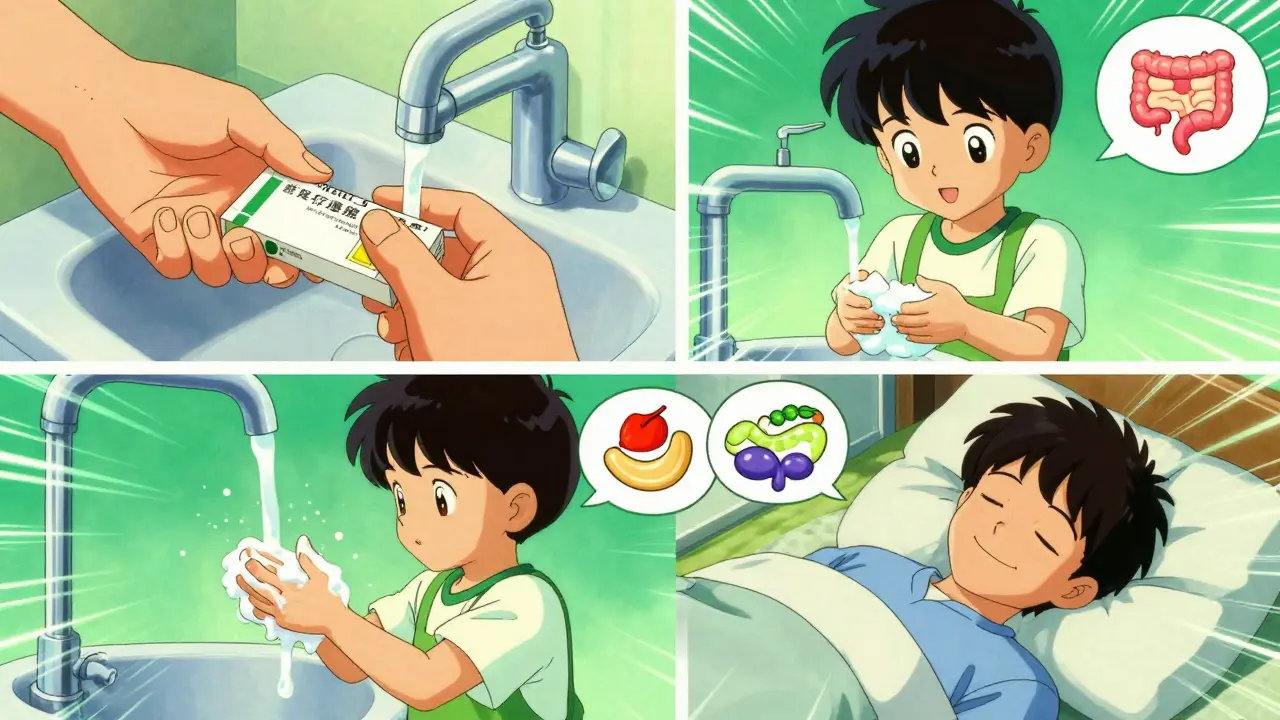
- Wash your hands with soap and water. Alcohol-based hand sanitizers don’t kill C. diff spores.
The CDC estimates that 30% fewer C. diff cases could happen by 2030 if we improve stewardship and roll out new microbiome therapies. But until then, the biggest risk factor is still the same: unnecessary antibiotics.
What Happens If You Don’t Treat It?
C. diff doesn’t always kill - but it can. Toxic megacolon. Colon perforation. Sepsis. These aren’t theoretical risks. They happen. A 2023 Mayo Clinic review found that untreated severe C. diff can turn fatal in under 72 hours. Even with treatment, older adults and people with weakened immune systems face a 1 in 5 death rate.
And recurrent infections? They’re a nightmare. Each relapse weakens the gut more. People start avoiding food. Lose weight. Feel hopeless. That’s why FMT isn’t just a last resort - it’s often the only real hope.
Can you get C. diff from someone else?
Yes. C. diff spores spread through feces and can survive on surfaces for weeks. If someone with the infection doesn’t wash their hands, they can contaminate doorknobs, toilets, or medical equipment. That’s why hospitals isolate patients and use special cleaning agents. In the community, it’s often spread in nursing homes or among family members caring for someone sick.
Is FMT covered by insurance?
Yes, in most cases. Medicare and private insurers cover FMT for recurrent C. diff after at least two failed antibiotic treatments. The cost of the procedure ranges from $1,500 to $3,000 - far less than the $11,000 average cost of a hospital readmission for another relapse.
Do you have to be hospitalized for FMT?
No. Most FMT procedures are outpatient. Colonoscopy and enema versions are done in a clinic or GI center. Oral capsules are taken at home under supervision. Recovery is usually quick - most people feel better within a day or two.
Can you get C. diff without taking antibiotics?
Yes, but it’s rare. People with weakened immune systems, those on chemotherapy, or those with long-term bowel diseases like IBD can develop C. diff without recent antibiotic use. Still, over 90% of cases are tied to antibiotics. If you’ve never taken them, your risk is extremely low.
Are there any long-term side effects of FMT?
So far, no major long-term side effects have been confirmed. But researchers are watching. Some studies suggest possible links to weight gain, metabolic changes, or even mood shifts - all tied to the gut-brain axis. Because FMT is relatively new, long-term data (10+ years) doesn’t exist yet. That’s why it’s only recommended for recurrent C. diff, not for general "gut health."
What’s Next?
The future of C. diff treatment is moving away from poop and toward precision. Companies are developing pills made of specific bacterial strains - no donor needed. SER-109 is already in late-stage trials. Others are testing engineered bacteria that target only C. diff, leaving the rest of your gut alone. These aren’t science fiction - they’re coming fast.
But until then, the lesson is simple: antibiotics save lives - but they also break something fragile. Your gut microbiome isn’t just background noise. It’s your body’s first line of defense. Treat it with care. Ask questions. Push back on unnecessary prescriptions. And if you’ve had C. diff more than once - don’t wait. FMT might be the answer you’ve been searching for.




After my third C. diff recurrence, I was ready to try anything. Vancomycin just made me feel worse-like my insides were being scraped with sandpaper. My GI doc mentioned FMT like it was a normal thing, and honestly? I laughed. Then I cried. The whole process was way less gross than I imagined. Oral capsules, no colonoscopy, just swallowed them like vitamins. Within 48 hours, the diarrhea stopped. Not slowed. Stopped. I’ve been symptom-free for 14 months now. If you’re on your third round, don’t wait. This isn’t magic. It’s biology. And it works.
Also-yes, hand sanitizer doesn’t kill C. diff spores. Soap and water. Always. I learned that the hard way when I reinfected my sister after a hospital visit. We’re both fine now, but I’ll never forget how scared I was. Don’t let pride keep you from asking for help.
As someone from India where antibiotics are sold over the counter without prescriptions, this post hits hard. I’ve seen grandparents get C. diff after a simple course of amoxicillin for a cold. No one connects the dots. We don’t have antibiotic stewardship programs. No one asks if they really need it. Just ‘take this, feel better.’
It’s terrifying how common this is here. I wish more people knew about FMT-not as a last resort, but as a logical next step. We need education, not just treatment. Maybe one day, community health workers will carry pamphlets on gut health like they do for diabetes.
My uncle had C. diff after a hip replacement. They gave him clindamycin for the infection, and two weeks later he was in ICU. They didn’t even test for C. diff until his kidneys started failing. That’s when they realized it wasn’t just a bad reaction-it was the antibiotics themselves.
He’s fine now, thanks to FMT. But I’ve told everyone I know: if you’re getting antibiotics, ask if there’s a narrow-spectrum option. Don’t just accept the first one they hand you. It’s not paranoia. It’s common sense.
Let’s be real. This whole ‘poop transplant’ thing is just a fancy way of saying doctors are desperate. They’ve been overprescribing antibiotics for decades, and now they’re trying to fix it by shoving someone else’s poop into your colon? That’s not medicine. That’s a last-ditch Hail Mary.
And don’t get me started on those ‘FDA-approved’ poop pills. You think they’re clean? You think they screened for everything? There’s a reason those early FMT cases had people dying from drug-resistant E. coli. It’s not science-it’s chaos with a FDA stamp.
I’d rather take my chances with vancomycin than risk turning my gut into a microbiome casino.
Okay but like… who even *wants* to swallow poop pills?? Like I get it’s science and all but come on. My grandma would have a heart attack if she knew her grandkid was taking a pill made from someone else’s butt juice. And don’t even get me started on the whole ‘donor screening’ thing. What if they miss something? What if the donor was secretly into weird stuff? Like, I don’t want to know if the person who donated had a 3am kebab habit or ate raw sushi every day for a year.
Also, why is no one talking about how this is just a bandaid? We’re not fixing the root problem-overprescribing antibiotics. We’re just patching it with poop. That’s not progress. That’s denial.
I’m a nurse in a rural ER. We see C. diff every week. I’ve watched people lose their jobs because they couldn’t leave the bathroom. I’ve held hands while they cried because they thought they were dying. And I’ve seen FMT turn people around in days.
It’s not about being gross. It’s about being human. The fact that we’re still treating this like a joke instead of a public health crisis is heartbreaking. We need more awareness. More training. More funding.
And yes-I’ve had patients ask if they can ‘just take a probiotic.’ I wish it were that easy. But it’s not. We’re not just fighting bacteria. We’re fighting ignorance.
So let me get this straight: we’ve got a medical breakthrough that’s 90% effective… and it’s called ‘poop.’
Of course. Because nothing says ‘modern medicine’ like a donor with a 5-star Yelp review for their gut health.
Meanwhile, Big Pharma is out here selling $3,700 monoclonal antibodies while the real solution is sitting in a toilet. I’m not mad. I’m just… impressed by the irony.
The fact that we’re still debating whether FMT is ‘gross’ while 30,000 people die annually from C. diff is the definition of societal dysfunction. We vaccinate people with live viruses. We inject them with mRNA. We transplant organs from dead people. But give someone a pill made from screened, processed, frozen stool from a healthy donor-and suddenly it’s ‘unnatural’?
It’s not about what it’s made of. It’s about what it does. FMT restores balance. It doesn’t just suppress symptoms. It fixes the ecosystem. And if you’re too squeamish to accept that, maybe you’re part of the problem.
Also, tetracyclines have the lowest risk? Then why isn’t doxycycline the first-line treatment for sinusitis? Because we’re not treating patients. We’re treating algorithms. And that’s why this keeps happening.
I work in a hospital pharmacy in Delhi. We get asked for antibiotics for viral infections all the time. Parents, teachers, even doctors. No one listens. I’ve tried explaining C. diff to patients. Most think it’s just ‘bad digestion.’
But I saw a girl, 19, come in with severe diarrhea after a 10-day course of ceftriaxone for a sore throat. She was in sepsis. She didn’t even know what antibiotics were. Just took what the local shopkeeper gave her.
Education needs to start young. Not just in hospitals. In schools. In villages. In homes.
As a microbiologist, I can confirm: FMT isn’t magic. It’s ecology. Your gut is a rainforest. Antibiotics are a chainsaw. FMT is replanting the trees.
But here’s what no one talks about: the donor microbiome matters. Not just ‘healthy’-but *diverse*. People from rural areas, farmers, those with traditional diets, tend to have more robust microbiomes. That’s why some FMT centers now screen for dietary history.
And yes-probiotics don’t work. Most commercial ones have 1-5 strains. Your gut has 1000+. You can’t fix a forest with five saplings.
Also, SER-109? Brilliant. But it’s still just a subset. We’re not there yet. We need personalized microbiome therapy. Not one-size-fits-all poop.
I had C. diff after a knee surgery. Vancomycin didn’t touch it. I was in pain for 8 months. My wife cried every night. Then we found a clinic doing FMT via capsules. I took them at home. Felt weird the first day. Like my stomach was rearranging itself. By day three? Normal. No more urgency. No more cramps.
It’s not just about survival. It’s about dignity. I didn’t want to live like that anymore. FMT gave me back my life. Not just my gut.
And yes-I still wash my hands with soap. Every time. No exceptions.
So you’re telling me we have a cure that’s cheaper than a hospital readmission, more effective than antibiotics, and backed by science… but we’re still making people feel ashamed to ask for it?
It’s not the poop. It’s the stigma. We treat gut health like it’s dirty. Like it’s something to whisper about.
Meanwhile, we’re okay with giving people chemo or brain surgery. But a pill made from poop? ‘Ew.’
That’s not science. That’s culture. And we need to fix the culture before we fix the gut.
The deeper question here isn’t about antibiotics or fecal transplants-it’s about our relationship with the human body. We’ve spent decades treating biology like a machine: replace the part, fix the error, optimize the output.
But the gut isn’t a carburetor. It’s a living, evolving, symbiotic ecosystem. And we’ve been treating it like a battleground, not a garden.
FMT works not because it introduces ‘good bacteria,’ but because it restores balance. It doesn’t attack-it invites. It doesn’t conquer-it collaborates.
Perhaps the real breakthrough isn’t the transplant. It’s the realization that healing sometimes means surrendering control. That medicine, at its highest level, isn’t about domination. It’s about harmony.
My cousin in Kerala got C. diff after a 14-day course of piperacillin-tazobactam. She was 32. No comorbidities. Just a simple UTI. She almost died. FMT saved her. But here’s the twist: she’s now a donor. Why? Because she realized she’s one of the lucky ones. And now she helps others.
She’s not ‘giving poop.’ She’s giving life. And she’s started a local initiative-‘Gut Guardians’-where people get screened to donate. No money. Just community. No stigma. Just science.
Imagine if every hospital had a ‘Gut Guardian’ program. Imagine if we taught this in high school biology. Imagine if we stopped calling it ‘poop’ and started calling it ‘microbiome restoration.’
We don’t need more drugs. We need more empathy. And a little less judgment.