
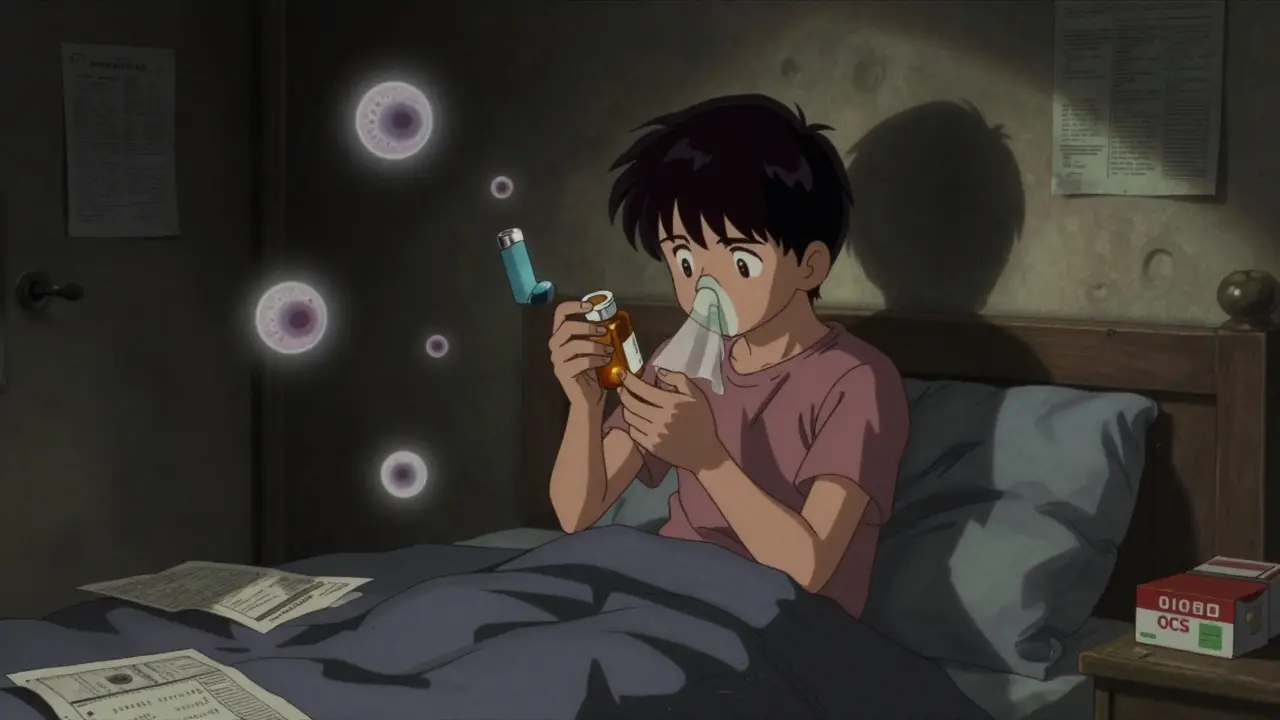
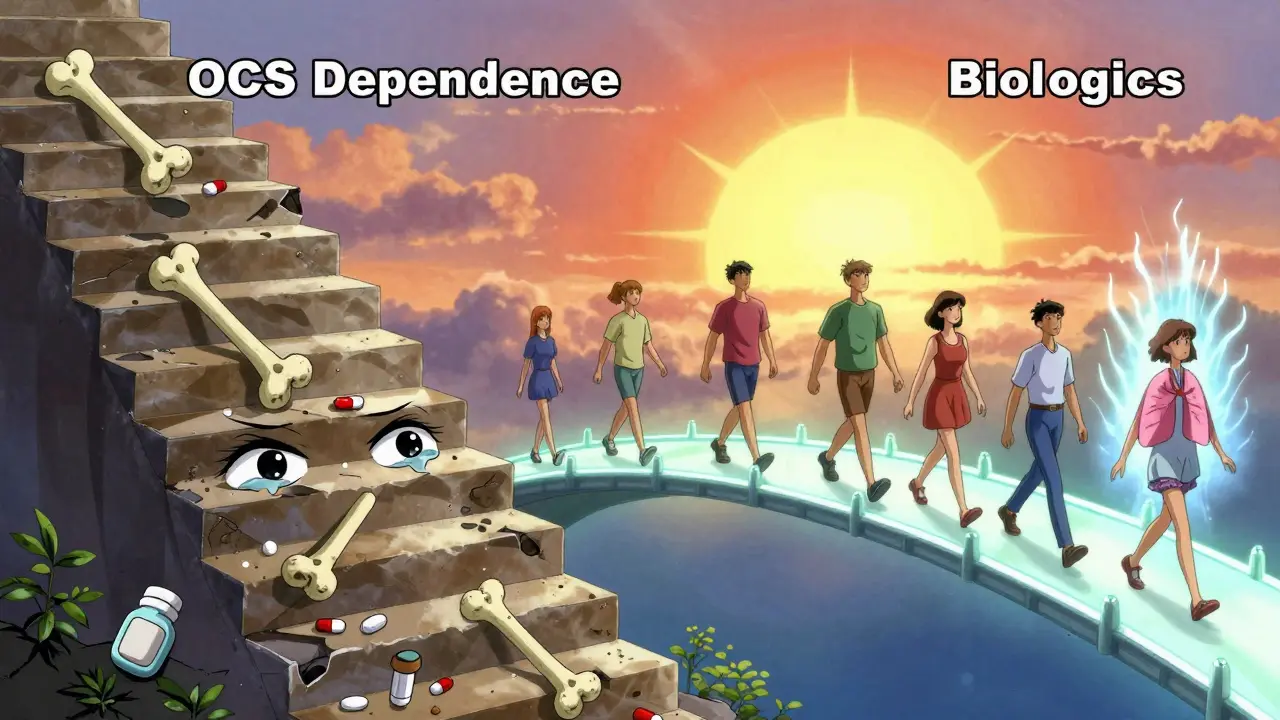
For decades, oral corticosteroids (OCS) have been the go-to rescue for severe asthma flare-ups. They work fast. They’re cheap. And for many, they’re the only thing standing between a hospital bed and breathing normally. But here’s the truth no one talks about enough: oral corticosteroids are a dangerous crutch. Even short courses can wreck your body over time. And long-term use? It’s not just risky-it’s life-shortening.
Think about it. You’re taking a pill every day just to keep your lungs from shutting down. You gain weight. Your bones thin. Your blood sugar spikes. You’re more likely to get infections, develop cataracts, or suffer a heart attack. And yet, you keep taking it because the alternative feels worse. That’s the cruel paradox of severe asthma management today.
Why Oral Corticosteroids Are a Hidden Crisis
It’s not just about how often you take OCS-it’s about how long. The Global Initiative for Asthma (GINA) says short courses should last 3 to 7 days during an attack. That’s fine. But when patients need them every few months, or worse, every week, that’s dependence. And dependence isn’t just medical-it’s personal. Patients call it a "safety net," but also a "necessary evil."
The numbers don’t lie. A 2025 study in Frontiers in Allergy found that 93% of people with severe asthma suffer complications directly tied to OCS use. Even if you’ve only taken a few short courses, the damage adds up. Weight gain. Diabetes. Depression. Osteoporosis. Adrenal insufficiency. These aren’t side effects you can ignore. They’re chronic conditions that require their own treatments, their own doctors, their own costs.
And then there’s the money. In Italy, the yearly cost of OCS-related complications for asthma patients hit €1,960 per person. That’s nearly double what non-asthma patients pay. Why? Because OCS themselves cost pennies. But the fallout? It’s expensive. Hospital visits. Bone density scans. Diabetes meds. Mental health care. All of it piles up.
The Biologic Revolution: A Real Alternative
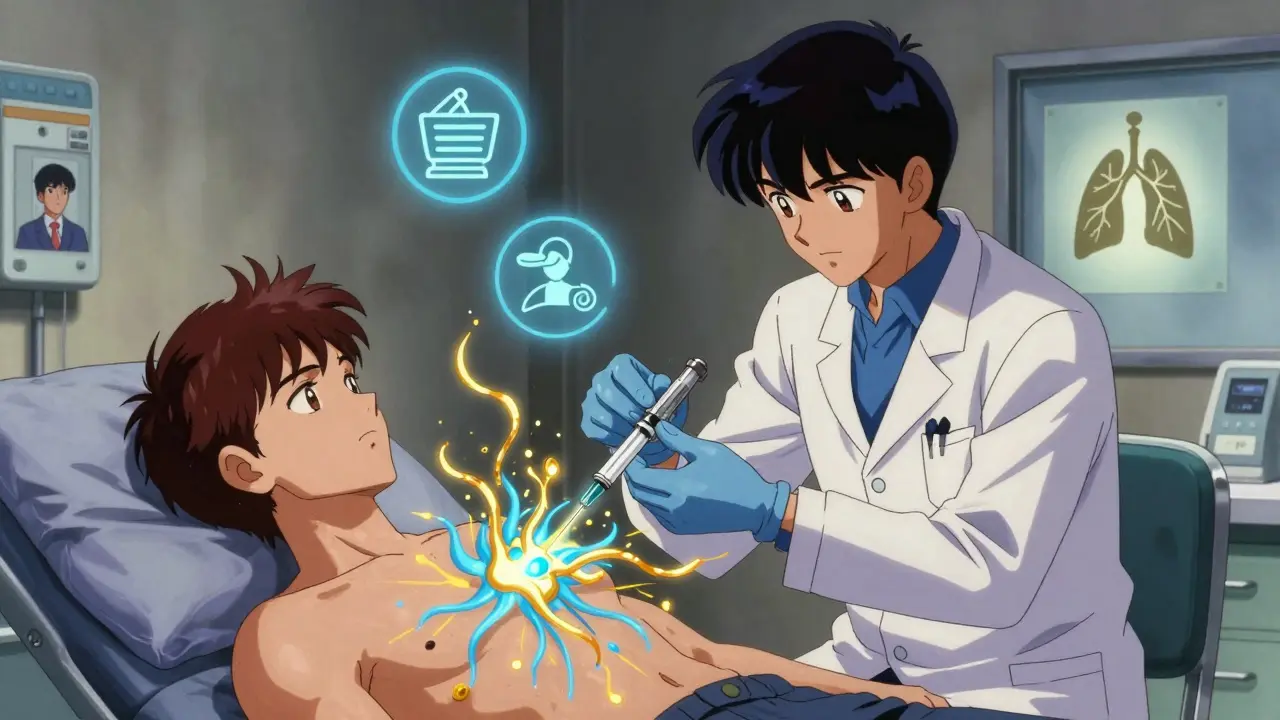
There’s a better way. And it’s not theoretical. It’s here. Biologics are targeted drugs that block specific parts of the immune system driving inflammation in asthma. They’re not pills. They’re injections-usually monthly or every few weeks. But they work differently. They don’t just suppress your whole immune system. They go after the exact problem.
Six biologics are approved for asthma right now: omalizumab, mepolizumab, reslizumab, benralizumab, dupilumab, and tezepelumab. They’re not for everyone. They work best for people with type 2 inflammation-that’s about half to two-thirds of severe asthma cases. But for those people? They’re game-changers.
Take mepolizumab. A 2023 study of 106 Italian adults with uncontrolled asthma showed dramatic results. After switching to mepolizumab:
- 79% of patients were dependent on OCS. After treatment? Only 31% still were.
- Those who still needed OCS cut their daily dose by nearly 5 mg.
- Exacerbations dropped from 4.1 per year to 0.8.
- Hospitalizations fell from 0.4 per year to 0.06.
Dupilumab did the same. The American Academy of Family Physicians confirmed it reduces both OCS use and flare-ups in corticosteroid-dependent patients. These aren’t small wins. They’re life-altering.
And here’s the kicker: even though biologics cost more upfront, they save money long-term. Fewer hospital trips. Fewer ER visits. Fewer broken bones. Fewer diabetes meds. The "shadow costs" of OCS-those hidden, delayed expenses-make biologics the smarter financial choice over time.
Why Aren’t More People Using Biologics?
If they work so well, why aren’t they everywhere?
Access. Cost. Complexity.
Biologics aren’t covered equally. In the U.S., a June 2024 move capped inhaler costs at $35/month for many-but it doesn’t help people on Medicaid or Medicare. Biologics? Still expensive. Some insurers require you to fail three other treatments before approving one. Others demand proof of type 2 inflammation through blood tests or FeNO measurements. Not every clinic can do those tests. Not every doctor knows how to interpret them.
And then there’s the fear. Patients are scared to stop OCS. They’ve been told for years that it’s their last line of defense. Doctors, too, are hesitant. There’s no universal tapering protocol. How do you slowly reduce steroids without triggering a crash? That’s still being figured out.
The EOS Network says it plainly: "More guidance is needed on how best to taper steroids safely." That’s the missing piece. Biologics are ready. But we’re not quite ready to let go of OCS.
Other Alternatives? Limited Help
What about bronchial thermoplasty? It’s a procedure where heat is used to shrink excess muscle in the airways. It’s been around for a while. The AAFP says it can improve quality of life and reduce flare-ups. But here’s the catch: in the first six weeks after treatment, asthma symptoms often get worse. It’s not a quick fix. And it’s only for people who’ve tried everything else and still can’t breathe.
What about vitamin D? Sounds simple, right? Take a supplement and fix inflammation. But multiple studies-including one from the AAFP in 2021-showed high-dose vitamin D added to standard asthma care didn’t prevent flare-ups or reduce hospital visits in adults, even those with low vitamin D levels. It doesn’t work.
There’s no magic pill. No herbal remedy. No breathing trick that replaces the need for targeted therapy. If you’re on daily OCS, you need something that tackles the root cause. And right now, biologics are the only proven path.
The Path Forward: What Needs to Change
We’re at a turning point. The science is clear. Biologics reduce OCS dependence. They save lives. They cut costs over time. But the system isn’t keeping up.
First, we need better guidelines for tapering steroids. Not guesswork. Not trial and error. Clear, step-by-step plans built on evidence. Second, access to biomarker testing (like blood eosinophils or FeNO) must become routine. You can’t target type 2 inflammation if you can’t measure it.
Third, payers need to stop treating biologics as "last resort" drugs. They’re not. They’re the next step-before OCS becomes a lifelong sentence. GINA already says this: for Step 5 severe asthma, add biologics before maintenance OCS. That’s the standard. Now we need every clinic, every insurer, every doctor to follow it.
And finally, patients need support. Not just medical. Emotional. Many have been on OCS for years. They’re scared to stop. They’ve lost weight, gained trust, and built routines around pills. Transitioning off requires coaching, monitoring, and patience. It’s not just about prescribing a new drug-it’s about changing a whole way of living.
The burden of OCS isn’t just physical. It’s psychological. It’s financial. It’s systemic. But it’s not inevitable. We have the tools. We have the evidence. What’s missing now is the will to use them.




I’ve been on OCS for 8 years. I didn’t think there was another way until my pulmonologist shoved a mepolizumab pamphlet in my hand. Now I’m down to one injection a month and I haven’t been to the ER in 18 months. My bones stopped aching. My sugar’s stable. I’m not cured-but I’m alive again.
Stop treating biologics like luxury items. They’re survival tools.
If you’re on daily steroids and can’t breathe, biologics aren’t a luxury-they’re your next step. Simple as that. No magic, no hype. Just science.
I hate how everyone acts like biologics are the holy grail. What about the people who can’t afford them? Or the ones who don’t have type 2 inflammation? You’re painting a black-and-white picture when the real world is full of grays.
And don’t get me started on the ‘shadow costs’ argument-hospitals are still billing like it’s 2003. The system’s broken, not the drugs.
The data presented here is compelling, and the clinical outcomes for biologics are well-documented. However, one must acknowledge the structural barriers that prevent equitable access. The disparity between private insurance coverage and Medicaid/Medicare limitations is not merely a policy gap-it is a moral one.
Biologics, while efficacious, remain inaccessible to those who need them most. This is not a failure of medicine. It is a failure of prioritization.
Let’s not romanticize biologics. They’re expensive, they require regular injections, and they don’t work for everyone. The idea that we can just swap out OCS for biologics and call it a day ignores the lived reality of patients who’ve been burned by failed treatments before.
And yes, OCS is toxic-but so is the trauma of being told you’re not ‘severe enough’ to qualify for help. We’re treating symptoms of a broken system like they’re medical problems. We need systemic reform, not just better drugs.
Also, the ‘shadow costs’ argument is disingenuous. The real cost isn’t the hospital visits-it’s the lost wages, the skipped meals, the shame of being a ‘non-compliant’ patient because you can’t afford the follow-up bloodwork.
Biologics are a band-aid on a hemorrhage. We need to stop pretending the system works.
My sister switched to dupilumab. Took 3 months to adjust. Now she’s off steroids. No more moonface. No more insomnia. She’s sleeping. Working. Laughing.
It’s not perfect. But it’s better.
i just want to say thank you for writing this. i’ve been on ocs for 12 years and no one ever told me the long term stuff. i thought i was just ‘getting old.’ turns out my bones are crumbling and my diabetes is steroid induced.
my doc just shrugged and said ‘you’re lucky you can breathe at all.’
now i’m on mepolizumab. still scared. but finally hopeful.
You people are so naive. Biologics cost $30k a year. Who’s paying for that? The government? You? Your kids?
And you think OCS is bad? Try being a nurse who’s seen 50 patients die because they couldn’t get the drug they needed because some insurance rep decided they weren’t ‘high enough risk.’
Stop pretending medicine is about health. It’s about money. Always has been. Always will be.
I cried when I got my first biologic shot. Not because I was happy. Because I realized I’d been living in fear for a decade. And no one told me there was another way.
😭
To the person who cried: I see you. I’ve been there. The fear of stopping OCS is real. Your body remembers what it’s been forced to rely on. Tapering is emotional as much as it is physical.
But you’re not alone. I’ve walked 12 patients through this. You will breathe again. Not perfectly. But better. And you’ll thank yourself for trying.
In India, access to biologics is nearly nonexistent. Even in metro hospitals, the cost is prohibitive. We have patients on OCS for 15+ years. No one has the luxury of a 2023 study.
Our reality: OCS is not a crutch-it’s the only lifeline.
Biologics are a privilege. Not a solution.
The author ignores the fact that 60% of severe asthma patients do not have type 2 inflammation. For them, biologics are irrelevant. The article reads like an ad for pharma.
Where are the studies on low-dose OCS + targeted immunomodulators? On precision inhalers? On AI-driven exacerbation prediction?
This is not progress. It’s marketing dressed as medicine.
The most critical missing piece is not access or cost-it’s clinician education. Most primary care providers have never seen a biologic in action. They don’t know how to interpret FeNO. They don’t know how to taper.
Until we train the frontline, biologics will remain a theoretical solution for patients who can’t even get a referral.
I’m a paramedic. I’ve pulled people out of asthma attacks with albuterol and OCS. I’ve seen them come back six weeks later, worse.
Biologics aren’t the answer for everyone. But for the ones who’ve been through hell? They’re the first real hope I’ve seen in 15 years.
Don’t let perfect be the enemy of life-saving.
OCS is a fucking poison pill wrapped in a plastic bottle and sold as salvation.
Biologics? They’re expensive. Yeah. But so is burying your kid because you couldn’t afford to stop the steroids that turned your lungs into dust.
Stop crying about cost and start crying about corpses. That’s the real math.