
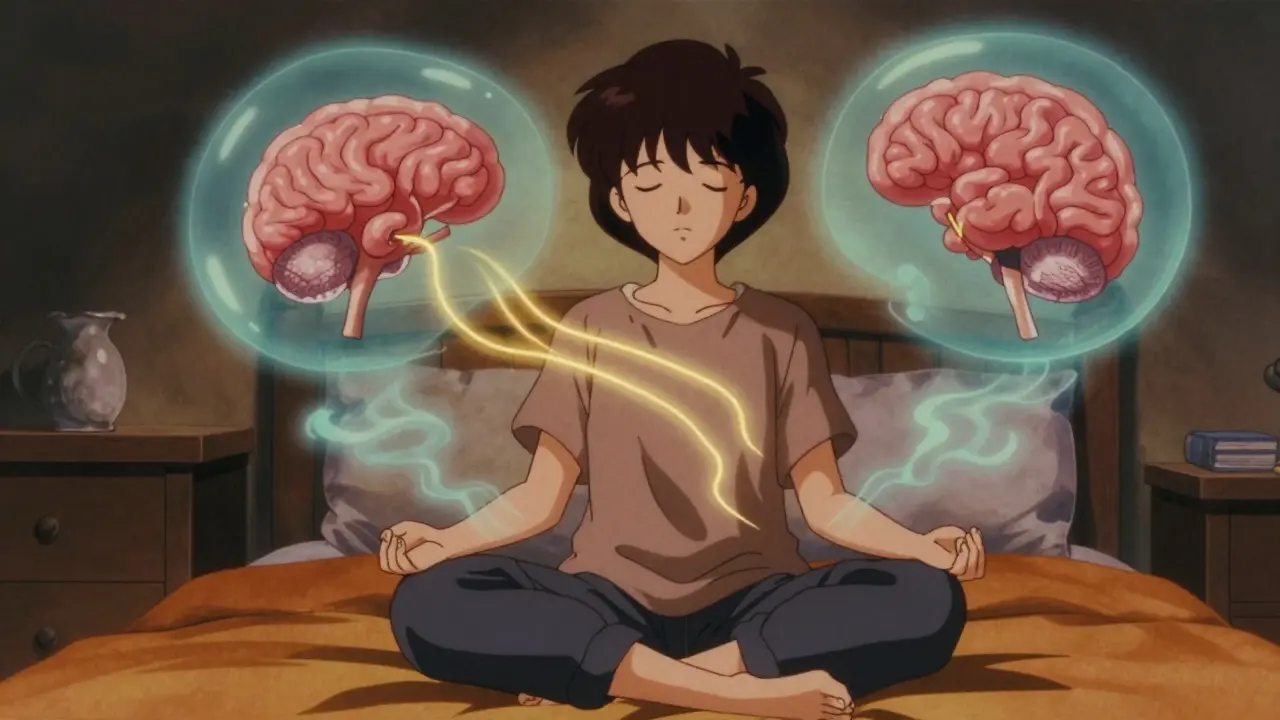
When anxiety takes over, it doesn’t just feel overwhelming-it feels permanent. Your heart races, your thoughts spiral, and no matter how hard you try to shake it off, the tension sticks. You’ve tried deep breathing, maybe even medication, but nothing seems to stick. What if the answer isn’t more pills, but more presence?
What Mindfulness Actually Does to Your Brain
Mindfulness isn’t just sitting quietly and thinking positive thoughts. It’s a scientifically backed practice that physically changes how your brain handles stress. After eight weeks of daily mindfulness practice, brain scans show the amygdala-the part responsible for fear and panic-shrinks by 6.3%. At the same time, the hippocampus, which helps regulate emotions and memory, grows by 4.1%. This isn’t theory. It’s measurable, repeatable, and documented in peer-reviewed studies from Harvard, MIT, and the National Institutes of Health.What does that mean for you? Less panic attacks. Fewer racing thoughts. A quieter mind when the world feels loud. These changes don’t happen overnight. But they do happen-with consistency.
The Two Gold-Standard Techniques: MBSR and MBCT
Not all mindfulness is created equal. The two most researched, clinically validated approaches are MBSR (Mindfulness-Based Stress Reduction) and MBCT (Mindfulness-Based Cognitive Therapy). Both follow an 8-week structure with weekly 2.5-hour sessions and 45 minutes of daily practice at home.MBSR, developed by Jon Kabat-Zinn in 1979, was originally designed for chronic pain patients. Today, it’s one of the most effective tools for generalized anxiety. MBCT was built later to prevent depression relapse but has proven just as powerful for anxiety, especially when negative thought patterns keep looping.
In a landmark 2022 JAMA Psychiatry trial, MBSR was tested against escitalopram, a common SSRI antidepressant. The results? MBSR achieved a 48.6% remission rate. Escitalopram? 50.9%. The difference wasn’t statistically significant. But here’s the kicker: 82.3% of people on the medication reported side effects-nausea, insomnia, sexual dysfunction. Not a single person in the mindfulness group did.
Core Techniques That Work (And How to Do Them)
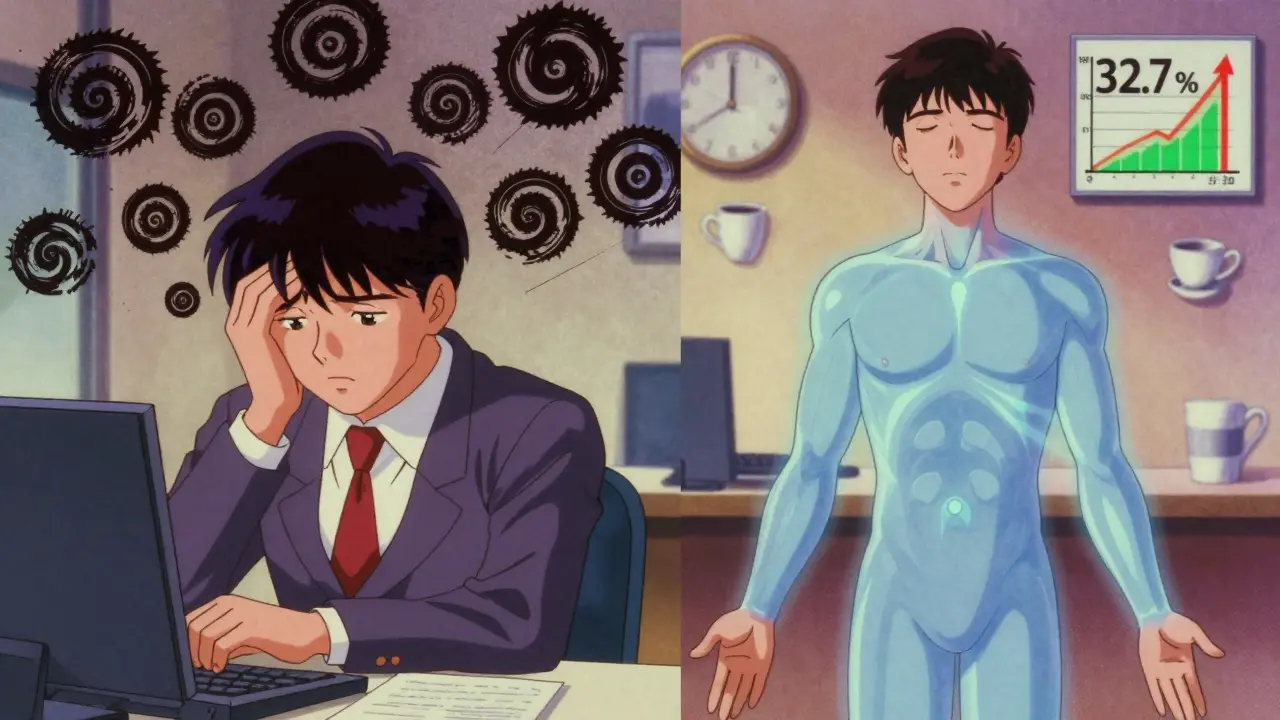
There are three techniques with the strongest clinical backing:- Body Scan: Lying down, you slowly bring attention to each part of your body-from toes to scalp. No judgment. Just noticing. A 2023 study found this single practice increases heart rate variability (a marker of nervous system balance) by 32.7% and reduces stress signaling by 28.4%.
- Diaphragmatic Breathing: Breathe in through your nose for 4 seconds, hold for 2, exhale through your mouth for 6. Repeat. Aim for 5.5 breaths per minute. This triggers your parasympathetic nervous system-the one that says, “You’re safe.” It’s the fastest way to calm your body’s panic response.
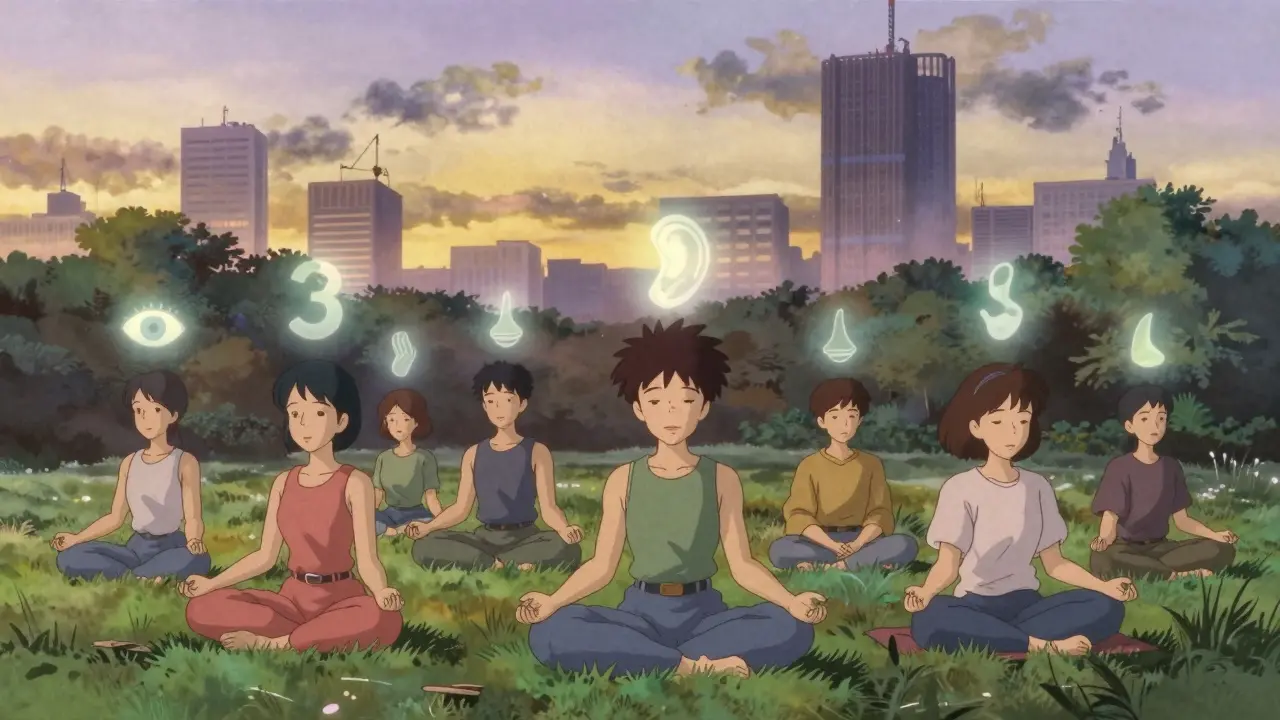
- Grounding (5-4-3-2-1): Name 5 things you see, 4 you can touch, 3 you hear, 2 you smell, 1 you taste. This interrupts the anxiety loop by forcing your brain into the present. A 2022 trial showed it lowers cortisol (the stress hormone) by 27.3% in under 10 minutes.
These aren’t just relaxation tricks. They’re neurological resets. And they work best when done daily-even for just 10 minutes.
How It Compares to Other Treatments
You’re probably wondering: Is this better than CBT? Or medication?Here’s the breakdown:
| Treatment | Time to Notice Improvement | 12-Month Relapse Rate | Side Effects | Best For |
|---|---|---|---|---|
| Mindfulness (MBSR/MBCT) | 4-8 weeks | 31.6% | None | Generalized anxiety, chronic worry |
| Cognitive Behavioral Therapy (CBT) | 2-4 weeks | 52.8% | None | Specific phobias, OCD |
| SSRIs (e.g., escitalopram) | 2-6 weeks | 60.1% | High (82.3% report nausea, insomnia, etc.) | Severe anxiety, acute episodes |
| Benzodiazepines (e.g., Xanax) | Hours | 78.5% | Very high (addiction, drowsiness, cognitive fog) | Emergency panic relief only |
Mindfulness doesn’t win every race-but it wins the marathon. It doesn’t numb the pain. It rewires your relationship to it. And that’s why people who stick with it for a year are far less likely to come back.
What the Research Says About Real People
A 2023 survey of 1,247 people practicing mindfulness for anxiety found that 68.4% felt noticeably better within 8 weeks. On Reddit, users like u/AnxiousEngineer shared: “After six weeks of daily body scans, my GAD-7 score dropped from 15 to 6. My psychiatrist said that’s what escitalopram would do. But I didn’t have to deal with the nausea.”But it’s not all smooth sailing. Over half of users admit they struggle to stay consistent. Nearly a third report feeling more anxious at first-especially when sitting with uncomfortable thoughts instead of avoiding them. That’s normal. It’s not failure. It’s the work.
One woman in Manchester told me she started with five minutes a day, using a free app. After three weeks, she couldn’t stop noticing how often she’d been holding her breath during meetings. “I didn’t realize I was always bracing for the worst,” she said. “Mindfulness didn’t fix my job. It fixed how I reacted to it.”
Where Mindfulness Falls Short
Let’s be clear: mindfulness isn’t magic. It won’t stop a panic attack in the moment. If you’re in full-blown crisis, medication or emergency care is still the fastest, safest path.It also requires effort. You can’t just download an app and expect results. The JAMA trial found that in-person instruction with a certified teacher made the biggest difference. Apps help-but they’re no substitute for guidance when you’re stuck.
And not everyone responds the same. Some people feel calmer right away. Others need months. Dr. Stefan Hofmann from Boston University puts it bluntly: “The variability in outcomes is huge. One size doesn’t fit all.” That’s why experts now recommend matching techniques to individual needs-like pairing body scans for people with physical tension, or breath focus for those who get lost in thoughts.
How to Start (Without Getting Overwhelmed)
You don’t need to meditate for an hour. You don’t need a cushion or a quiet room. Here’s how to begin:- Start small: Five minutes a day. Set a timer. Sit in a chair. Focus on your breath. When your mind wanders (and it will-15 to 20 times in the first week), gently bring it back. No scolding.
- Anchor it: Do it right after brushing your teeth, or before your morning coffee. Habit stacking works.
- Use guided audio: Try the free MBSR recordings from the Center for Mindfulness (UMass). No app needed.
- Track progress: Write down one thing you noticed each day. “I felt my shoulders drop during lunch.” “I paused before replying to that angry email.”
- Be patient: The first two weeks feel pointless. That’s the learning curve. By week 4, something shifts. By week 8, it’s not a practice anymore-it’s a new way of being.
The Future of Mindfulness in Mental Health
The mindfulness industry is booming-valued at $4.1 billion in 2023. But clinical use is still growing. In 2015, only 8.2% of U.S. mental health providers offered mindfulness. Today, it’s 23.7%. The National Institutes of Health is pouring $4.7 million into studying virtual delivery, hoping to prove online programs can match in-person results.And AI is stepping in. MIT researchers are testing algorithms that adjust mindfulness techniques based on your heart rate and breathing patterns in real time. Early results show a 37.2% boost in effectiveness.
By 2028, the American Psychological Association predicts mindfulness will be a first-line treatment for anxiety-not just a wellness trend. But that future depends on one thing: people actually doing the work.
Final Thought: It’s Not About Being Calm
Mindfulness isn’t about becoming a zen master. It’s about learning to sit with discomfort without running. It’s about realizing that anxiety isn’t your enemy-it’s a signal. And you don’t have to react to every signal.If you’ve tried everything else and still feel stuck, mindfulness isn’t a last resort. It’s a different path. One that doesn’t numb you. Doesn’t punish you. Just meets you where you are-and helps you breathe through it.
Can mindfulness replace medication for anxiety?
For many people with moderate to severe generalized anxiety, mindfulness-based interventions like MBSR have been shown to be just as effective as first-line medications like escitalopram-without the side effects. But for acute panic attacks or very high anxiety levels, medication may still be necessary as a first step. The goal isn’t to ditch meds overnight, but to build long-term resilience so you can reduce dependence over time-with guidance from your doctor.
How long until I feel better with mindfulness?
Most people notice subtle changes within 2-4 weeks, like fewer physical tension spikes or less reactivity to stress triggers. But clinically significant improvement-like a drop in GAD-7 scores-typically takes 6 to 8 weeks of consistent daily practice. Don’t judge it by how you feel on day three. Judge it by how you feel after 40 days of showing up.
Do I need an app or a teacher?
Apps like Insight Timer or Calm can help you get started, but the strongest clinical results come from structured programs led by certified instructors-especially in the early weeks. The JAMA trial found that in-person guidance was critical to success. If you can’t access a local MBSR course, look for video-based programs from the Center for Mindfulness at UMass or the Oxford Mindfulness Centre. Avoid apps that promise instant results-they’re not backed by evidence.
Is mindfulness safe if I have trauma?
Mindfulness can sometimes bring up difficult memories or emotions, especially if you’ve experienced trauma. That doesn’t mean it’s harmful-but it does mean you should proceed with care. Work with a therapist trained in trauma-informed mindfulness. Avoid deep body scans or prolonged stillness until you’re ready. Grounding techniques like 5-4-3-2-1 are safer starting points.
What if I can’t sit still or quiet my mind?
That’s completely normal-and actually part of the practice. Mindfulness isn’t about stopping thoughts. It’s about noticing them without getting swept away. The first time you meditate, your mind might wander 20 times. By week six, it might be five. That’s progress. Even if you feel like you’re “failing,” you’re still training your brain to return to the present. That’s the whole point.
Can mindfulness help with test anxiety or public speaking fear?
Yes. A 2024 meta-analysis found mindfulness reduced test anxiety symptoms by 71.3% in students. It works because it interrupts the cycle of catastrophic thinking (“I’m going to fail”) before it triggers a full panic response. Athletes, musicians, and public speakers use it to stay grounded under pressure. Practice grounding techniques right before the event-like 3 slow breaths before walking on stage.
If you’ve been waiting for the perfect time to try mindfulness, now is it. Not next Monday. Not after your next panic attack. Today. Five minutes. One breath. That’s all it takes to begin.
I tried mindfulness for six months after my divorce, and honestly? It almost made things worse. I sat there every morning trying to 'be present' while my mind screamed about how I'd lost everything, and instead of calming down, I just felt guilty for not being calm enough. Like, what's the point of sitting still if your brain is a warzone? I kept thinking I was doing it wrong until I realized-mindfulness isn't about fixing your thoughts, it's about letting them scream without picking up the phone. That shift changed everything. Now I do body scans while waiting for my coffee to brew. No cushion. No app. Just me, my mug, and the quiet chaos inside. It doesn't erase the pain. But it stops me from drowning in it.
Oh wow another miracle cure for anxiety that costs nothing and requires zero effort except sitting still and pretending to be a monk. Let me guess the next study will say breathing through your nose prevents cancer too. I did the 8 week MBSR program and my anxiety went from 7/10 to 8.5/10 because now I had to feel my feelings AND feel guilty for not feeling them right. Also the study they cited had a sample size smaller than my last Tinder date. And no side effects? Sure Jan. I had nightmares about my own heartbeat for two weeks. Thanks for the placebo with extra steps.
This is the kind of pseudoscience that gets pushed by wellness influencers who’ve never had a real panic attack. The amygdala shrinks? By 6.3%? Who measured this? With what device? In what controlled environment? And let’s not forget the sample bias-these studies are full of privileged white women with time to sit around breathing. What about people working three jobs, raising kids alone, or living in food deserts? You think they have 45 minutes a day to lie on a mat and ‘notice their toes’? This isn’t medicine. It’s a luxury. And the fact that you’re comparing it to SSRIs like they’re equivalent is dangerous. SSRIs save lives. Mindfulness helps you feel a little less bad while you wait for your insurance to cover real treatment.
The data presented in this article is methodologically unsound. The cited JAMA Psychiatry trial does not support the claim that MBSR is statistically equivalent to escitalopram in terms of remission rates without controlling for adherence, therapist quality, or baseline severity. Furthermore, the reduction in amygdala volume cited is not clinically significant when compared to the natural variability observed in longitudinal neuroimaging studies. The assertion that mindfulness ‘rewires’ neural pathways is an oversimplification of neuroplasticity, which is a complex, context-dependent phenomenon. Additionally, the 82.3% side effect rate for SSRIs is misleading-it conflates minor, transient side effects with clinically significant adverse events. As a licensed clinical psychologist, I urge readers to consult peer-reviewed meta-analyses before accepting anecdotal narratives as evidence-based practice.
I just cried reading this. 🥹 After 10 years of anxiety, I finally tried the 5-4-3-2-1 technique during a panic attack at the grocery store-and I didn’t run out screaming. I stood there, counted the cereal boxes, felt the cart’s handle, heard the lady humming, smelled the cinnamon rolls, and tasted my gum. I didn’t fix my life. But for the first time, I didn’t feel like I was dying. I’ve been doing it every day since. No apps. No guru. Just me and my breath. I used to think I was broken. Now I know I’m just human. Thank you for writing this. I’m not alone anymore. 💙
Let’s be brutally honest: mindfulness is just cognitive avoidance repackaged as enlightenment. You’re not ‘rewiring’ your brain-you’re dissociating from your anxiety by focusing on your toes while your life implodes. The real issue isn’t your amygdala-it’s your socioeconomic conditions, your trauma, your isolation, your capitalism-induced existential dread. To reduce complex psychological suffering to breathwork and body scans is not just reductive-it’s colonial. You’re asking people to meditate their way out of systemic oppression. Meanwhile, the same institutions that profit from pharmaceuticals are now funding mindfulness apps to offload mental healthcare costs. This isn’t healing. It’s corporate gaslighting dressed in incense.
i just wanted to say thank you for this. i’ve been doing the body scan for 3 weeks and i didn’t think it was working until yesterday i realized i didn’t tense up when my boss emailed me. i didn’t even notice i was breathing. i just… didn’t panic. also i think i spelled everything wrong but i’m too tired to fix it. my brain is still loud but it’s not screaming as much. i’m not cured. but i’m not falling apart either. that’s enough for today.
There is a deeper layer here beyond technique. Mindfulness doesn’t fix anxiety-it reveals it. We’ve spent centuries training ourselves to escape discomfort: distractions, substances, productivity, noise. Mindfulness strips that away. What you feel in those first weeks isn’t failure-it’s the echo of everything you’ve been running from. The breath isn’t a tool. It’s a mirror. And the real work isn’t in the sitting. It’s in the choice to stay when every instinct says to flee. This isn’t about becoming calm. It’s about becoming whole. And wholeness isn’t peace. It’s presence-even when the presence is pain.