
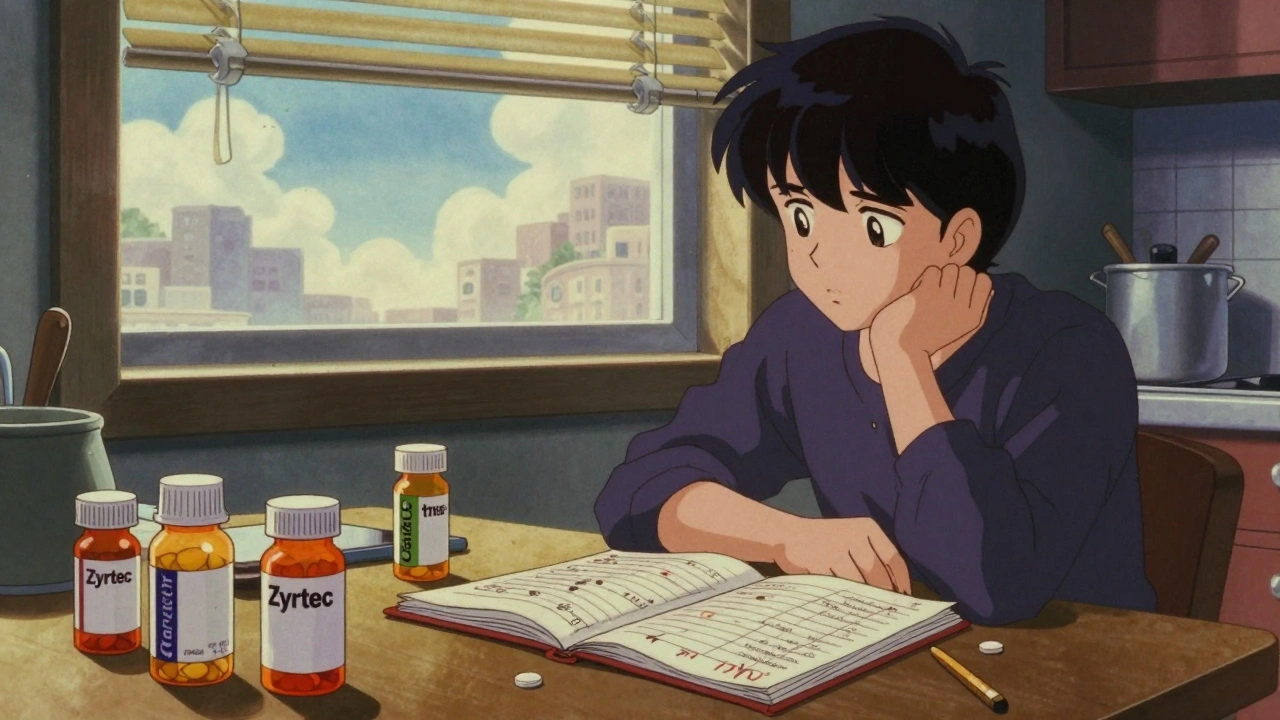
Have you been taking Zyrtec, Claritin, or Allegra for months-or years-and suddenly noticed your allergies aren’t under control like they used to be? You’re not imagining it. Millions of people report the same thing: their go-to allergy pill just doesn’t seem to work like it used to. But here’s the catch: antihistamine tolerance isn’t as simple as your body getting used to the drug. The truth is messier, and understanding it could save you from unnecessary dose hikes, wasted money, or even worse symptoms.
What’s Really Happening When Antihistamines ‘Stop Working’?
It’s easy to blame the medication. You take the same dose, same time, same brand-and suddenly, your eyes itch, your nose runs, your throat feels tight again. But in most cases, the problem isn’t the drug losing power. It’s your body’s environment changing. Think of it like this: if you’ve lived in a quiet neighborhood your whole life and then a new airport opens nearby, you don’t suddenly become deaf. You’re just exposed to more noise. Same with allergies. Over time, you might develop new sensitivities-maybe to mold in your basement, pet dander from a new roommate, or pollen levels that have climbed due to climate shifts. Your immune system isn’t broken. It’s just reacting to more triggers than before. A 2022 Mayo Clinic survey of 350 chronic allergy sufferers found that 41% believed their antihistamines had become less effective. But only 17% had actually tracked their symptoms with logs or apps. The rest were guessing. And when they switched to nasal sprays or allergy shots, 68% reported better control. That’s not tolerance. That’s poor treatment matching.Is There Such a Thing as True Pharmacological Tolerance?
Here’s where things get controversial. Some doctors say yes. Others say no. And both sides have data. Dr. John M. James, a board-certified allergist with over 30 years of experience, says patients on long-term antihistamines like Zyrtec can develop tolerance. He’s seen it in his practice: people needing higher doses just to get the same relief. On the other hand, Dr. Robert Graham at Lenox Hill Hospital says true receptor-level tolerance to second-gen antihistamines like fexofenadine or loratadine is exceptionally rare. Why? Because H1 receptors-the ones antihistamines block-don’t typically downregulate like opioid or benzodiazepine receptors do. Your body doesn’t build a tolerance the same way it does to sleeping pills or painkillers. The European Academy of Allergy and Clinical Immunology (EAACI) takes a middle ground: patients report reduced effectiveness, but it’s more likely due to worsening disease than drug tolerance. And a 2017 study in Clinical and Translational Allergy found that 78% of chronic urticaria patients didn’t respond to standard antihistamine doses. But when doctors increased the dose up to eight times the normal amount, nearly half of them got significant relief. That’s not tolerance. That’s underdosing. So what’s the real takeaway? If your antihistamine isn’t working, it’s probably not because your body got used to it. It’s more likely you need a stronger dose, a different drug, or a better treatment plan.Why Some People Swear They Need to Rotate Antihistamines
On Reddit’s r/Allergies, 78% of users who responded to a 2023 poll said they rotated between Zyrtec, Claritin, and Allegra because one stopped working. It’s a common habit. But is it helpful? There’s no solid science backing rotation therapy. Switching from cetirizine to loratadine won’t reset your receptors. These drugs all block the same H1 receptors-they’re just chemically different. If your body truly developed tolerance to one, it’d likely respond the same way to others in the same class. That said, some people do feel better after switching. Why? Maybe they were taking a low-dose generic version and switched to the brand. Maybe they started taking it with food, which can affect absorption. Or maybe they were actually developing a new allergy, and the new antihistamine just happened to work better for that trigger. Bottom line: rotation isn’t a proven strategy. But if you feel better switching, it’s not harmful-unless you’re doubling up on doses or mixing with decongestants without medical advice.
When Higher Doses Are the Answer (and When They’re Not)
The EAACI guidelines say it’s safe to increase second-generation antihistamines up to four times the standard dose for chronic urticaria. That means 20 mg of Zyrtec instead of 10 mg, or 180 mg of Allegra instead of 60 mg. Studies show this works for nearly half of people who seem resistant. But here’s the catch: this only applies to non-sedating antihistamines. First-gen drugs like Benadryl? Don’t go higher. They cause drowsiness, dry mouth, and even confusion in older adults. And while newer antihistamines are safer, the FDA warned in 2021 about cardiac risks with extremely high doses-even though those risks are minimal with drugs like fexofenadine or cetirizine at fourfold levels. If you’re thinking about upping your dose, talk to your doctor first. Don’t just open another bottle and double up. Also, don’t confuse dose escalation with combination therapy. Products like Allegra-D mix antihistamines with pseudoephedrine, a decongestant. That’s not stronger antihistamine action-it’s adding a different kind of relief. Sales of these combos rose 12% in 2022, showing people are desperate for answers. But decongestants aren’t meant for daily long-term use. They can raise blood pressure and cause rebound congestion.What Actually Works When Antihistamines Fall Short
If your allergy symptoms are still bad after trying higher doses or switching antihistamines, it’s time to look beyond pills. Nasal corticosteroids-like Flonase or Nasacort-are the gold standard for allergic rhinitis. A 2023 update from the American Academy of Otolaryngology found that 73% of patients who switched from antihistamines to nasal sprays saw major improvement. Why? Because antihistamines only block one part of the allergic reaction. Corticosteroids calm the entire inflammation process in your nose. Allergy shots (immunotherapy) are another powerful option. They work by slowly training your immune system to stop reacting to allergens. Subcutaneous immunotherapy (injections) shows 60-80% long-term success, according to the ACAAI. Sublingual tablets (placed under the tongue) are slightly less effective at 40-60%, but much more convenient. It takes months to see results, but many patients stay symptom-free for years after stopping treatment. And then there’s Xolair (omalizumab), a biologic injection approved for chronic hives that don’t respond to antihistamines. In clinical trials, 50-60% of patients had complete symptom relief. It’s expensive and requires monthly shots, but for people who’ve tried everything else, it’s life-changing.
What You Should Do Right Now
If your antihistamine isn’t working like it used to, here’s your action plan:- Track your symptoms. Use a free app or notebook. Note when symptoms flare, what you were exposed to, and what you took. This helps separate real tolerance from environmental changes.
- Check your dose. Are you taking the full recommended dose? Many people take half-doses because they’re worried about side effects. That’s fine for occasional use-but not for chronic allergies.
- Try a nasal spray. Even if you’ve never used one, give Flonase or Nasacort a shot for two weeks. You might be surprised.
- See an allergist. If symptoms persist, get tested. You might have developed new allergies you didn’t know about. Skin prick tests are quick, cheap, and accurate.
- Don’t panic-switch. Rotating antihistamines won’t fix the root problem. Focus on treatment upgrades, not drug cycling.
Myths vs. Reality: Quick Facts
- Myth: Antihistamines lose effectiveness over time because your body gets used to them. Reality: True pharmacological tolerance is rare. More often, your environment or allergy burden has changed.
- Myth: Taking Benadryl every night for sleep causes tolerance. Reality: Yes, it does-but not because of the antihistamine effect. It’s because your brain adapts to the sedation. Don’t use it long-term for sleep.
- Myth: Switching from Zyrtec to Claritin resets your system. Reality: Both work the same way. You’re not rebooting your receptors.
- Myth: Antihistamines are dangerous if taken long-term. Reality: Second-generation antihistamines are among the safest medications on the market. Even at fourfold doses, they’re well-tolerated by most adults.
The bottom line? Your allergy meds aren’t failing you. You might just need a better strategy. Antihistamines are great for mild, occasional symptoms. But if you’re dealing with daily sneezing, itchy eyes, or hives that won’t quit, it’s time to think bigger. Talk to a specialist. Test your triggers. Try a nasal spray. Consider immunotherapy. You don’t have to keep reaching for the same pill that doesn’t work anymore.






I’ve been on Zyrtec for six years straight. Last spring, it stopped working entirely-no matter how much I took. I started tracking symptoms with a notebook like the article suggested, and turns out, I developed a mold allergy from a leaky basement. Nasal spray fixed it in two weeks. Sometimes it’s not the drug-it’s the environment.
It is imperative to elucidate that the pharmacological mechanisms underlying antihistamine efficacy are frequently misinterpreted by laypersons who lack formal training in immunology. The assertion that tolerance is a myth is not only scientifically dubious but also dangerously reductive. One must consider the epigenetic modulation of H1 receptors under chronic exposure, which, while not classical downregulation, nonetheless constitutes a form of adaptive resistance. The Mayo Clinic data cited is statistically significant but methodologically flawed due to self-reporting bias.
Okay but have you heard of Xolair?? Like, it’s literally the MVP of allergy treatment. I had chronic hives for 3 years, tried everything-Zyrtec, Claritin, even those weird sublingual tablets. Nothing. Then my allergist said, ‘Let’s try the biologic.’ First shot? Magic. Second? I forgot what itching felt like. It’s expensive, yes-but so is living in misery. This article? 10/10. Someone get this woman a medal.
kinda makes you wonder if we’re just over-medicalizing normal immune responses. like, maybe our bodies aren’t broken, maybe the world just got weirder. pollen levels up, air quality down, we’re all living in a giant petri dish of allergens. antihistamines are bandaids on a hurricane. i’ve been using a neti pot daily for a year. not perfect, but way less pills. also, i spell ‘allergy’ wrong sometimes. sorry.
This is all a cover-up. The pharmaceutical industry doesn’t want you to know that antihistamines are designed to fail after 6 months so you keep buying them. They’ve been working with the EPA to increase airborne allergens. Also, nasal sprays? They’re laced with corticosteroids to make you dependent. Don’t trust the FDA. Don’t trust the allergists. Don’t trust this article. I’ve been living off garlic and apple cider vinegar since 2019. I haven’t sneezed once.
Why are we listening to American doctors? In India, we’ve been treating allergies with turmeric, neem, and steam inhalation for centuries. You think a pill fixes everything? Ha! Your bodies are weak from processed food and AC. Go outside. Breathe. Sweat. Your immune system will thank you. And no, I don’t need a nasal spray-I need a revolution.
Ugh. I’m so tired of people acting like antihistamines are harmless. You think it’s fine to take them daily? That’s just lazy self-care. Real people don’t need pills-they need discipline. I haven’t taken anything since 2021. I meditate, I avoid dairy, I wear a mask when I walk outside. And guess what? I’m healthier than all of you. Also, why are you all so obsessed with drugs? 🙄
I’ve been reading up on this for months now and I think there’s a really important nuance here that’s being overlooked. Even if true pharmacological tolerance is rare, the perception of reduced efficacy creates a psychological feedback loop-people start doubting the medication, which increases their focus on symptoms, which makes them feel worse, which reinforces the belief that the drug isn’t working. It’s not just biology-it’s cognitive bias layered on top of environmental triggers. I’ve seen this in my patients with chronic migraines too. The body doesn’t change, but the mind does. And that changes everything.
how can u trust america for allergy advice? they use chemicals in everything. even the air is toxic. i tried zyrtec for 2 months and got worse. then i switched to indian herbal medicine-neem, tulsi, ginger tea. now i dont even need pills. also i dont spell good but i know truth. you guys are too soft.
Nasal sprays work. Try them.
I rotated Zyrtec and Claritin for a year because I thought it’d help. It didn’t. Then I started using a HEPA filter in my bedroom and stopped using scented laundry detergent. My allergies vanished. Sometimes the fix isn’t stronger meds-it’s just cleaning up your space. Also, I’m not a doctor, but I play one on Reddit.
The EAACI guidelines are clear: dose escalation up to 4x is safe and effective for chronic urticaria. But the real issue is access. Many patients can’t afford to see an allergist, can’t get prescriptions for nasal corticosteroids without prior authorization, and are stuck with OTC generics at subtherapeutic doses. The problem isn’t tolerance-it’s systemic healthcare failure. We need better insurance coverage for immunotherapy and diagnostic testing. Not more myths. More access.
It is profoundly regrettable that the public discourse surrounding antihistamine efficacy has devolved into a cacophony of anecdotal assertions and pseudoscientific speculation. The clinical literature, as cited in this article, is both rigorous and compelling. One must, however, remain cognizant of the distinction between therapeutic response and placebo effect. The elevation of patient anecdotes above evidence-based medicine constitutes a dangerous erosion of scientific literacy. I urge all readers to consult peer-reviewed journals, not Reddit threads, for medical guidance.