
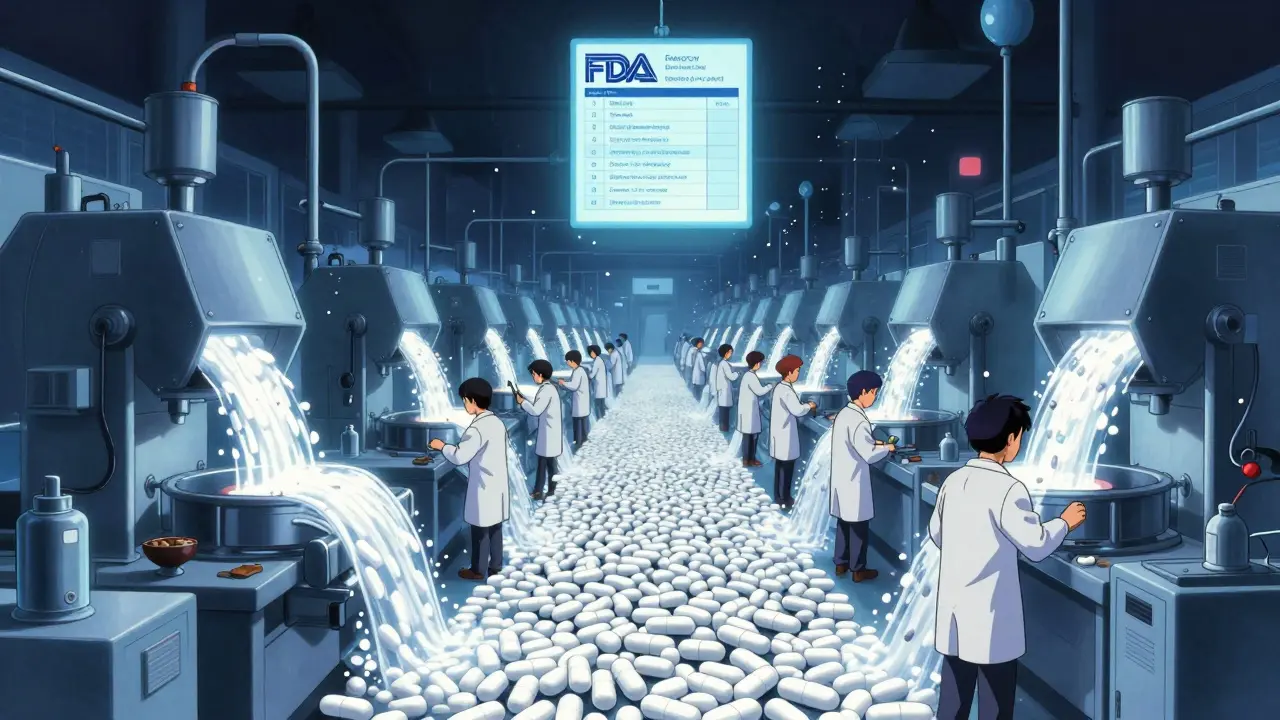
When you pick up a prescription, you probably don’t think about who made the pill or how much it cost to produce. But behind every drug-whether it’s a brand-name or generic-is a complex web of labor, regulation, and economics. And the difference in labor costs between generic and brand-name drugs isn’t just a number on a balance sheet. It’s why your generic prescription costs $4 instead of $40.
Why generic drugs cost less (and it’s not just the pill)
Generic drugs aren’t cheaper because they’re made of cheaper materials. The active ingredient in a brand-name drug and its generic version is identical. So why the huge price gap? The answer lies in what happens before the pill even leaves the factory. Brand-name drugmakers spend years and billions developing a new drug. The FDA says it takes about $2.6 billion and 10 to 15 years to bring a new molecular entity to market. That money goes to research, clinical trials, patents, and marketing. When the patent expires, generic manufacturers step in. They don’t have to repeat all that work. They just have to prove their version works the same way. That cuts their upfront costs by over 90%. But labor? That’s where things get interesting.Labor isn’t just about wages-it’s about volume
In brand-name drug production, labor makes up 30% to 40% of total manufacturing costs. Why? Because these companies are running smaller batches, often with complex formulations, and they’re doing it in highly regulated environments in the U.S. or Europe. Each batch gets intense scrutiny. Scientists, technicians, and quality control teams are constantly testing, documenting, and adjusting. There’s less automation because the production volume is low. Generic manufacturers? They flip that model. They produce hundreds of thousands, sometimes millions, of doses of the same drug. That massive scale changes everything. When production volume doubles, generic manufacturers cut their unit costs by 27%-far more than brand-name makers, who only see a 17% drop. That’s economies of scale in action. More pills made = less labor per pill. Think of it like this: making 100 custom cakes by hand takes a lot of time and skilled bakers. Making 10,000 identical cupcakes on an assembly line? You need fewer people, less training, and less time per unit. That’s what happens in generic drug manufacturing.The hidden labor cost: compliance and quality control
You might think generics are cheaper because they cut corners. But that’s not true. The FDA requires generic drugs to meet the same standards as brand-name drugs. That means every batch is tested. Every ingredient is tracked. Every machine is calibrated. And all of it is documented. Quality control alone accounts for over 20% of total generic production costs. That’s labor-intensive work. Lab technicians test raw materials. Pharmacists verify potency. Engineers monitor environmental controls. All of it has to be recorded in triplicate. A 2017 FDA analysis found that medium-sized generic firms spend about $184,000 a year just on compliance systems. Add in $1.9 million for program participation and $320,000 per new drug application, and you’re looking at serious labor overhead. The difference? Brand-name companies spread those costs across fewer units. Generics absorb them across millions.Where the work happens-and who pays for it
Here’s where it gets real: most of the active ingredients in generic drugs are made overseas. About 80% of APIs (active pharmaceutical ingredients) come from India and China. And there, labor costs are roughly 42% lower than in the U.S. That doesn’t mean workers are underpaid because they’re lazy. It means labor markets, regulatory environments, and infrastructure differ drastically. A 2021 HHS report pointed out these cost differences aren’t about efficiency-they’re about subsidies, weaker labor protections, and massive scale. In India, a single plant might produce 50 different generic drugs at once. In the U.S., a plant might make one or two. That’s why a generic drug made in India and shipped to the U.S. can cost 15% less at the pharmacy counter-even before you factor in U.S. economies of scale.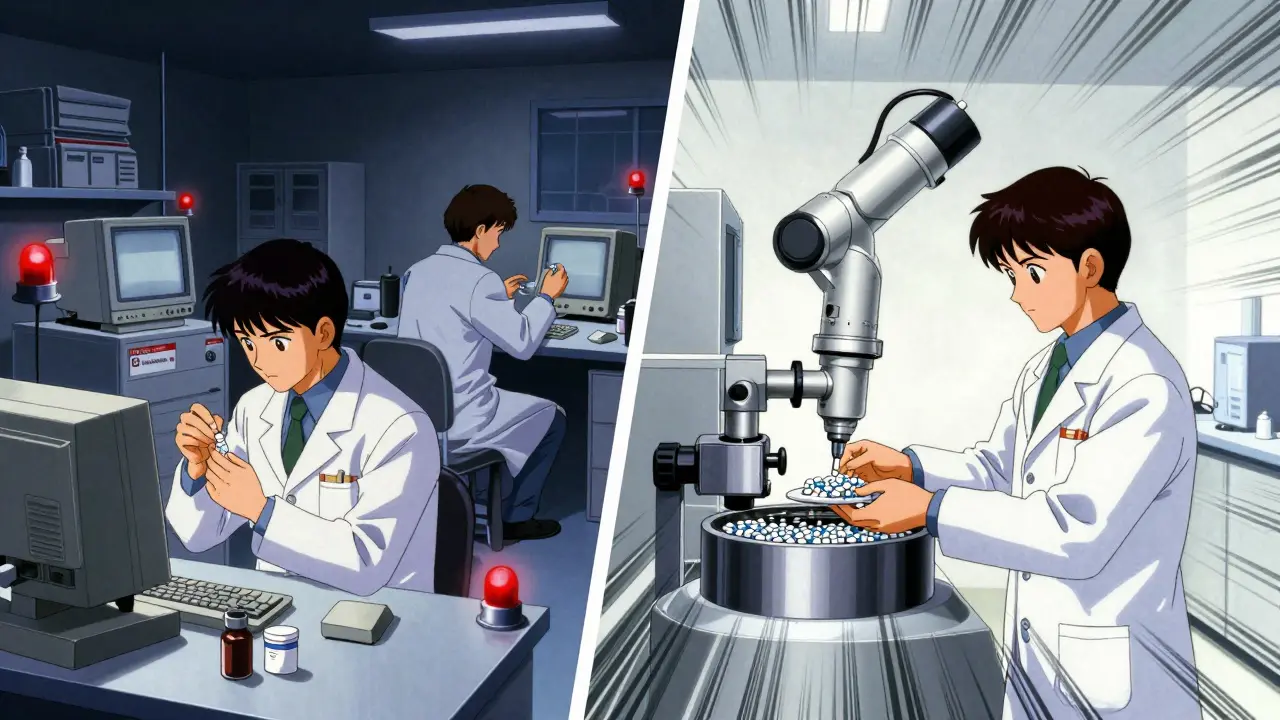
Contract manufacturing: shifting labor from fixed to variable
More and more generic manufacturers are outsourcing production to Contract Manufacturing Organizations (CMOs). In biosimilar production, 42% of costs go to CMOs. For small-molecule generics, it’s still 28%. That’s a smart move. Instead of paying salaries, benefits, and training for a full-time team, they pay per batch. If demand drops, they scale back. If demand spikes, they hire extra capacity. It turns labor from a fixed cost into a variable one. This shift lets generic companies stay lean. They don’t need giant factories. They don’t need hundreds of full-time employees. They just need a network of reliable partners.The pressure is real-and it’s changing how labor is used
The more generic competitors enter the market, the lower prices go. When three companies make the same drug, the price drops. When five do? It drops again. That pressure forces manufacturers to do more with less. The FDA has warned that this pressure might lead companies to reduce staffing, cut training, or delay equipment upgrades. Less labor doesn’t always mean better efficiency. Sometimes, it means risk. But here’s the twist: the smartest generic manufacturers are investing in labor-not cutting it. They train their teams to prevent errors before they happen. They automate testing where it makes sense. They use data to predict failures before they occur. One manufacturer that reduced rework by 30% through better training cut its total production cost by 22%-even though labor expenses went up slightly.What does this mean for you?
You’re not just saving money when you choose a generic. You’re benefiting from a system built on volume, efficiency, and global supply chains. The labor behind your $4 pill isn’t cheap-it’s optimized. Brand-name drugs pay for innovation. Generic drugs pay for access. And the labor behind them? It’s structured differently, scaled differently, and distributed differently. But it’s still there. Every pill you take was handled, tested, and tracked by real people. The real question isn’t whether generics are made with less labor. It’s whether we’re willing to let that labor be squeezed so thin that quality suffers. Right now, the system works. But it’s a tightrope walk-and it’s getting narrower.
Key labor cost comparisons
| Factor | Brand-Name Drug Production | Generic Drug Production |
|---|---|---|
| Labor as % of total cost | 30%-40% | 15%-25% |
| Primary labor driver | R&D support, small-batch QC, regulatory documentation | High-volume QC, compliance systems, batch tracking |
| Production volume per facility | Low (hundreds of thousands of units) | Very high (millions of units) |
| Typical labor location | U.S., EU, Japan | India, China, U.S. (CMOs) |
| Cost reduction per volume doubling | 17% | 27% |
| Quality control labor cost | 15%-20% of COGS | 20%+ of COGS |
What happens when labor gets cut too far?
In 2022, a major generic manufacturer in the U.S. shut down a production line because they couldn’t afford to hire enough qualified QC staff. The result? A shortage of a common blood pressure medication. Hospitals scrambled. Patients switched to more expensive brand-name alternatives. This isn’t rare. The FDA reports that drug shortages are increasing, and labor shortages are a growing factor. When companies cut too deep on staffing, they risk errors, delays, and recalls. That’s when the cost savings vanish-and patients pay the price.Final thought: Labor isn’t the enemy
It’s easy to think of generic drugs as “cheap labor” products. But that’s misleading. The labor behind generics is precise, regulated, and critical. It’s not about hiring fewer people. It’s about hiring smarter, scaling better, and automating wisely. The system works because it’s designed for volume, not perfection. And as long as competition stays strong, prices will stay low. But if we push too hard on cost-cutting, we risk breaking the very system that makes generics possible.Why are generic drugs cheaper if they’re made to the same standards?
Generic drugs are cheaper because their manufacturers don’t have to repeat expensive research, clinical trials, or patent development. They also produce far more units per batch, which lowers labor costs per pill. Even though quality standards are identical, the scale and efficiency of generic production drive down the price.
Do generic drugs use less skilled labor?
Not necessarily. The same FDA regulations apply to both brand and generic production. Workers in generic manufacturing are often highly trained in quality control, batch documentation, and compliance systems. The difference is in volume and specialization-generics rely on repetitive, high-throughput processes that require consistency more than innovation.
Is it true that most generic drugs are made overseas?
Yes. About 80% of active pharmaceutical ingredients (APIs) in U.S. generic drugs come from India and China. This is due to lower labor costs, large-scale manufacturing capacity, and decades of investment in pharmaceutical infrastructure. Finished pills may be packaged in the U.S., but the core ingredient is typically produced abroad.
How does competition affect labor costs in generic drug manufacturing?
More competition drives prices down, which forces manufacturers to cut costs-including labor. Some companies respond by investing in automation and training to reduce errors. Others cut staff, which can lead to quality issues or supply shortages. The most successful generic makers balance efficiency with reliability, knowing that one recall can wipe out years of savings.
Can labor cost reductions lead to drug shortages?
Absolutely. When manufacturers cut too deeply on staffing-especially in quality control and compliance-they increase the risk of production errors. A single failed batch can delay shipments for weeks. The FDA has linked recent drug shortages to underfunded labor systems in generic manufacturing, where companies can’t afford to maintain enough trained personnel to meet demand.





generic drugs arent cheaper because of labor. its because big pharma overcharges for everything. also who cares if the pill is made in india? i just want it to work.
this is so cool 😊 i never realized how much goes into making a $4 pill. the people working those lines? they’re heroes. thank you for explaining this so clearly!
oh please. 'labor is optimized'? you mean exploited. india's workers get paid pennies and work 14 hour days. dont pretend this is some clever efficiency. its colonialism with a pill bottle.
so let me get this straight - we outsource the hard labor to countries with weaker regulations, then act shocked when something goes wrong? 🤔 classic america. we want cheap meds but dont wanna see how the sausage is made. ironic much?
as someone from nigeria, i see this pattern everywhere. global supply chains thrive on asymmetry - rich countries demand low prices, poor countries supply cheap labor. the real issue isnt whether labor is cut - its whether we ever ask who’s paying the real cost. the human cost. the dignity cost. the future cost.
Thank you for this thoughtful breakdown. It's important to recognize that economies of scale do not equate to diminished quality. The rigorous FDA standards applied to generic manufacturers ensure safety and efficacy, even as production volumes increase. This is a model worth preserving.
i read this whole thing and still think generics are just bad. like, why does mine taste weird? 🤷♀️
you say '80% of apis come from india and china'... but did you know the fda has been caught approving batches with trace amounts of carcinogens? they're letting it slide because 'costs'. this isn't efficiency - it's a cover-up. 🕵️♂️💉
we make 50 drugs in one plant here. no big deal. workers trained. machines clean. simple.
this is actually a really good overview. the real win is how smart manufacturers are using data and training to prevent errors before they happen. investing in people, not cutting them - that’s the future.
they're all connected. big pharma owns the generic companies. the 'competition' is fake. the whole system is rigged. you think you're saving money? you're just feeding the same monster. 🤫💊
i just take my meds. i dont care who made them. as long as they work. 🤷♀️
The labor behind the pill is not merely a cost center - it is the ontological foundation of pharmaceutical integrity. To reduce it to a metric of efficiency is to forget that the pill, as an artifact, is the product of human intention, vigilance, and care. The system works not because it is cheap, but because it is attended - even if we refuse to see the attendants.
so we're supposed to be impressed that the same pill costs $4 because we outsourced the humans? how noble. next you'll tell me the wifi is free because we let a third world country host the server. 🤡
i love how this post highlights global interdependence. the fact that a woman in mumbai and a technician in ohio are both keeping your heart medicine safe? that’s beautiful. we’re all connected. let’s not pretend one side is 'better' - we need each other.